

Respecting the Thin Gold Line: When to Display It for 911 Dispatchers
Sep 16, 2026
The Thin Gold Line honors 911 dispatchers and public-safety telecommunicators, the men and women who answer the call before anyone else can respond. A gold or yellow stripe set against a black-and-white field represents their role as the vital, often unseen link between someone in crisis and the help racing toward them. Unlike military or department insignia, this symbol carries no official government standard. It grew from the dispatch community itself.
TL;DR:
- The thin gold line symbol for dispatchers emerged from a tradition of tribute symbols representing various emergency services, with no official government standard for the color.
- Gold signifies both the value of dispatchers’ unseen work and their role as the vital link coordinating responders without being physically present at incidents.
- Recognizing dispatchers with the gold line aims to address their lack of acknowledgment and supports advocacy for better mental health resources and official classification as first responders.
- The symbol appears in flags, decals, apparel, and memorials, but lacks standardization and can be confused with other yellow or gold uses in unrelated contexts.
- Displaying the gold line respectfully requires clear context, appropriate occasions like memorials, and supporting organizations focused on dispatchers’ recognition and well-being.
Table of Contents
- What Does the Thin Gold Line Symbolize?
- Who Are 911 Dispatchers, and Why Recognition Matters
- How the Thin Gold Line Appears in Flags and Apparel
- Where the Thin Gold Line Came From
- The Thin Gold Line’s Role in Advocacy and Mental Health
- Is the Thin Gold Line Controversial?
- How to Display the Thin Gold Line Respectfully
- Where to Learn More About the Thin Gold Line
- Why Brass & Bunker Co Covers Thin-Line Symbols
- Gear That Honors the Voice Behind the Headset
- Sources
- FAQ
What Does the Thin Gold Line Symbolize?
The thin gold line meaning traces back to a broader family of tribute symbols. The original, the Thin Blue Line, honors police officers. Others followed: red for firefighters, white for EMS, green for corrections and border enforcement. Each stripe sits on the same black-and-white flag, and each color marks a different group carrying weight most people never see up close.
Gold fits the dispatcher role for a reason that goes beyond aesthetics. Industry training resources describe dispatchers as the unseen but essential role in every emergency response, the person working the radio and the phone while officers, medics, and firefighters get the credit for what happens on scene. Some in the field call dispatchers the “golden glue,” a phrase that captures how they hold a response together without ever leaving the console.
The symbolism works on two levels:
- Value. Gold has always signified worth, and dispatchers are frequently the least visible piece of the emergency chain despite being the first voice a caller hears.
- Connection. The stripe represents a link, not a lead. Dispatchers coordinate everyone else without ever setting foot at the scene themselves.
That combination, value plus connection, is why the gold line resonates with people who work dispatch consoles for a living. It names something colleagues already understood but rarely saw put into a symbol.
Who Are 911 Dispatchers, and Why Recognition Matters
A dispatcher’s shift does not watch like what television shows depict. It starts with taking a call from someone who may be panicked, injured, or unable to speak clearly, and it requires extracting a location and a threat assessment in seconds. From there, the job splits into several demanding tasks at once.
- Determining the nature and severity of the emergency while the caller is still talking
- Giving real-time instructions, including CPR guidance or bleeding control, before any unit arrives
- Coordinating which police, fire, or EMS units respond, and tracking their status throughout the call
- Managing multiple simultaneous incidents without losing track of any single one
- Staying on the line with a caller through the worst moment of that person’s life, then moving to the next call
Dispatchers absorb trauma secondhand, call after call, with none of the physical action that gives responders on scene a way to process what happened. They hear the worst of an incident and rarely learn how it ended. The EMS1 profile of dispatch work describes this as functioning simultaneously as counselor, investigator, and coordinator, often without any closure on the outcome.
That gap, between doing critical work and getting recognized for it, is exactly what the gold line was built to close.
How the Thin Gold Line Appears in Flags and Apparel
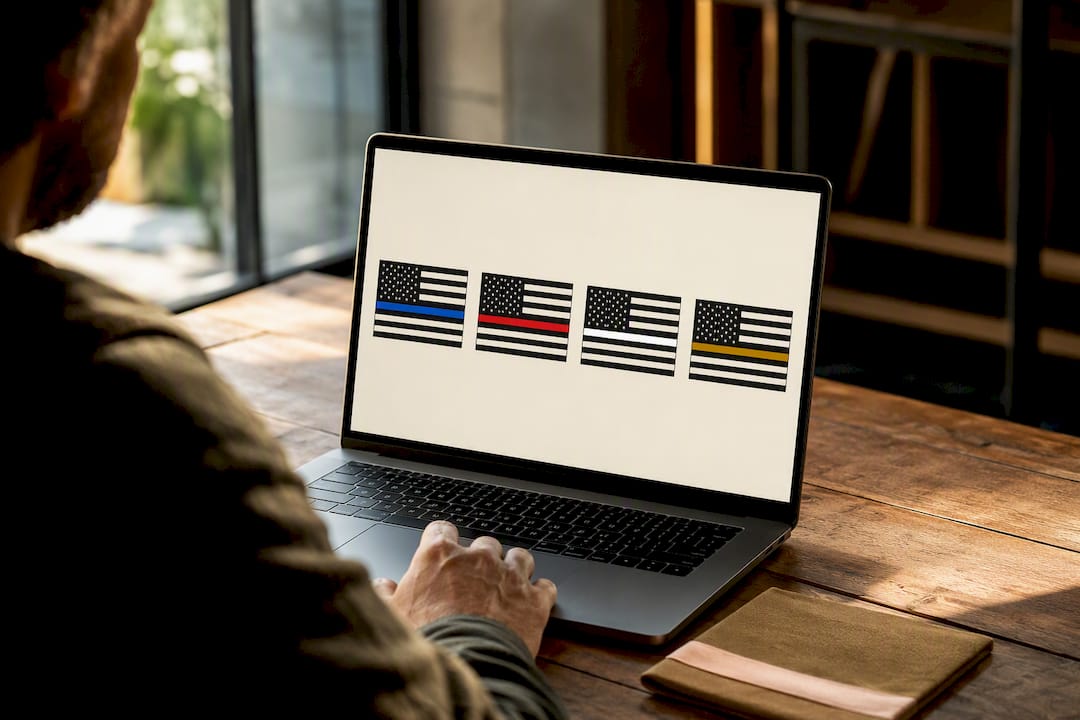
The most common design is a black-and-white American flag with a single horizontal gold or yellow stripe running through the center. It mirrors the layout used for other thin-line flags, keeping the visual language consistent across the whole family of tribute symbols.
You will also see the symbol show up in a few other forms:
- Vehicle decals and window stickers, often paired with a dispatcher headset icon
- Embroidered patches worn on jackets or displayed in dispatch centers
- Apparel, including shirts and hats, worn by telecommunicators and their families
- Memorial displays honoring dispatchers who died in the line of duty
One detail trips up a lot of people: “gold” and “yellow” get used interchangeably, and there is no governing body that has settled on one term. Explainers note that the thin yellow line flag is not standardized, so color naming and exact shade can vary by manufacturer or region without changing the meaning behind it. If you see both terms used to describe what looks like the same flag, that is expected, not a sign that someone got it wrong.
Where the Thin Gold Line Came From
The gold line did not appear out of nowhere. It followed the pattern set by the Thin Blue Line, which itself borrowed structure from military and law enforcement tradition to represent police officers as the barrier between order and chaos. As that visual language spread, other first-responder communities adapted it to their own roles, red for fire, white for EMS, and eventually gold for dispatch.
Dispatchers had a specific reason to want their own version. They are frequently left out of “first responder” conversations entirely, despite being first in the chain every time. Grassroots recognition built through dispatch forums, training content, and word of mouth long before any formal organization picked it up.
Training-focused publishers helped push it further into the mainstream. 911Training.net has published explainer content aimed directly at “those who wear the headset,” framing the gold line as recognition long overdue for a role that gets treated as clerical rather than critical. Advocacy groups followed, turning informal solidarity into organized campaigns. The timeline runs roughly parallel to the broader thin-line movement’s expansion through the 2010s and into the 2020s, driven less by any single founding moment than by a community deciding it needed its own symbol.
The Thin Gold Line’s Role in Advocacy and Mental Health
Beyond identification, the gold line functions as an organizing tool. The Thin Gold Line Foundation uses the symbol to push for two related goals: better mental-health resources for telecommunicators and formal recognition of dispatch as a first-responder profession in states where it still is not classified that way.
That advocacy translates into specific, on-the-ground outcomes:
- Peer-support programs designed for the unique stress of dispatch work
- Training initiatives aimed at reducing burnout and turnover in communication centers
- Campaigns pushing state legislatures to reclassify dispatchers as first responders for benefits and retirement purposes
- Memorial recognition for telecommunicators who died from job-related conditions, including suicide linked to cumulative trauma
Pro Tip: If you want to support this work directly, look for a dispatcher advocacy organization with a public accountability profile, similar to a nonprofit’s Candid listing, before donating. It confirms the group is doing more than selling merchandise under the symbol’s name.
Is the Thin Gold Line Controversial?
Not everyone embraces the gold line without pushback, and it is worth addressing that honestly rather than pretending the symbol is universally accepted. Some public discussion, including debate visible in community forums, questions whether adding yet another color to the thin-line family dilutes the original meaning behind the Thin Blue Line or turns tribute symbolism into something closer to a trend.
Other criticisms focus on practical confusion rather than principle:
- Color ambiguity. Gold and yellow stripes are also used informally in other contexts, including tow-truck and private-security symbolism, which can muddy intent if the display lacks context.
- No standardization. Because there is no official body governing the symbol, quality and messaging vary widely from one product or campaign to the next.
- Politicization concerns. Thin-line symbols in general have picked up political associations in some circles, which can overshadow the intended tribute for viewers unfamiliar with the dispatch community.
The counterpoint from dispatchers and their advocates is straightforward: the role genuinely lacks recognition compared to officers, firefighters, and paramedics, and a distinct symbol gives that recognition a visible form. Concerns about ambiguity argue for using the symbol with clear context, not for abandoning it.
How to Display the Thin Gold Line Respectfully
Context matters more than the object itself. A gold-line flag flown outside a dispatch center reads very differently than the same flag used without explanation somewhere unrelated to public safety.
- Reserve it for genuine support contexts. Memorial events, dispatcher appreciation weeks, and inside communication centers are natural, unambiguous settings.
- State the meaning when the context isn’t obvious. Because the symbol has no official government status, a short note or caption prevents confusion with unrelated yellow-line uses.
- Choose apparel and gear built to hold up. A symbol meant to honor sustained, difficult work deserves better than a shirt that fades after a few washes.
- Avoid implying formal endorsement. The gold line is a grassroots tribute, not a government-issued emblem, and messaging should reflect that.
Pro Tip: If you’re organizing a display for a dispatch center or a memorial event, pair the gold line with a short explanation of what telecommunicators actually do. Most people outside the field have no idea the role exists as its own profession.
Where to Learn More About the Thin Gold Line
A handful of sources cover this symbol from different angles worth knowing about. The 911 Training Institute writes from inside the dispatch training world and speaks directly to telecommunicators about the meaning behind the gold line. The Thin Gold Line Foundation focuses on advocacy, mental-health support, and formal recognition efforts, and its nonprofit profile is a good starting point if you want to contribute. LegalClarity breaks down the flag’s design and the color-naming inconsistency in plain terms, while Theflags offers a concise explainer on the symbol’s tribute intent for readers encountering it for the first time.
Why Brass & Bunker Co Covers Thin-Line Symbols
Brass & Bunker Co was built by a firefighter and a product designer who both understood the same thing: gear that honors this work has to mean something, not just look the part. That’s why we write about symbols like the Thin Gold Line before we ever sell a single stitch tied to them. Getting the history and the intent right comes first.
Our goal with pieces like this one is simple: educate, honor, and build apparel durable enough to carry that meaning for years, not one season. If you want the fuller picture of how thin-line symbolism developed, our explainers on the Thin Blue Line and the Thin Red Line cover where this tradition started and how it grew.
— Brass & Bunker Co
Gear That Honors the Voice Behind the Headset
Dispatchers rarely get a uniform, a badge, or a moment at the scene, which is exactly why wearing the gold line matters to the people who love and support them. Brass & Bunker Co builds apparel with an emphasis on durability and heritage-first craftsmanship, aiming to honor first responders rather than following trends.

A sticker on a vehicle or a laptop is a low-cost way to start the conversation about what telecommunicators do all day. For dispatchers, their families, and the departments that back them, our Firefighter Apparel collection and full range of t-shirts and hats are built to hold up through years of wear, not fade after a season. If you’re shopping for a gift that respects what the badge or the headset stands for, consider browsing the collection to find a suitable piece.
Sources
- 911 Training Institute — About / For Those Who Wear the Headset
- Thin Gold Line Foundation — profile
- What Does the Thin Yellow Line Flag Mean? - LegalClarity
- Theflags
FAQ
What does “thin blue line” mean?
The Thin Blue Line is a symbol honoring police officers, typically shown as a black-and-white flag with a single blue stripe representing law enforcement’s role as a barrier between order and chaos. It’s the original tribute symbol that later inspired variations like the Thin Gold Line for dispatchers.
What does a dispatcher say when you call 911?
Dispatchers follow structured call protocols, typically confirming the emergency type, location, and immediate danger before giving instructions or dispatching units. Exact phrasing varies by agency and call type, but the priority is always getting location and threat information fast.
What does gold line mean?
In the context of first-responder symbolism, the gold line represents 911 dispatchers and telecommunicators, honoring their role as the essential but often unseen link in emergency response. The color also appears in unrelated contexts like towing or private security, so context determines the meaning.
Why are 911 operators so calm?
Dispatchers train specifically to control their tone and pacing because a steady voice helps callers stay focused enough to follow instructions during a crisis. That calm is a practiced skill built through training and repetition, not the absence of stress, since dispatchers absorb significant secondhand trauma over a career, as noted in EMS1’s coverage of dispatch work.

