

One Rule That Decides Challenge Coin Etiquette for First Responders
Sep 17, 2026
Challenge coin etiquette comes down to one rule: if you’re checked, produce your actual coin within your group’s allowed reach or time, or you cover the agreed penalty. Everything else, from how you initiate a check to how you present a coin as a gift, builds on that foundation. Local and unit customs vary, so confirm the specifics with your group before you assume the standard rules apply everywhere.
TL;DR:
- Challenge coin checks typically require producing a real coin within one to four steps or time, with failure usually resulting in buying the next round or paying a penalty.
- The challenge should be initiated audibly at a hard surface or with a loud call, though some groups accept quiet taps in formal settings to avoid damage or attention.
- When giving or receiving a coin, presentation should be respectful, either through a discreet handshake pass or a ceremonial handoff that explains its significance.
- Coins should be carried in a secure manner, stored carefully in cases or displays, and cleaned with a soft cloth without abrasive cleaners to maintain their appearance.
- Timing and setting are crucial; coin checks are inappropriate during solemn, official, or emergency situations, and rules vary by unit, so clarify local customs before initiating a check.
Table of Contents
- What Are the Core Rules of a Challenge Coin Check?
- How Should You Give or Receive a Challenge Coin?
- How Should You Carry and Display Your Coins?
- When Is It Wrong to Call a Challenge Coin Check?
- Do Challenge Coin Rules Vary by Unit or Group?
- Where Does This Guidance Come From?
- Why Etiquette Still Matters More Than the Coin Itself
- Wear the Same Respect You Carry in Your Coin
- Sources
- FAQ
What Are the Core Rules of a Challenge Coin Check?
A coin check starts the moment someone slams their coin on a bar, table, or any hard surface within earshot. Some groups hold the coin aloft instead, or simply call out “coin check” loud enough for the room to hear. Tradition often demands an audible sound for the challenge to count, which is part of why a quiet tap rarely satisfies a strict crowd. Once the challenge lands, every person present is on the clock.
Pro Tip: Carry your coin somewhere you can reach in one motion. Fumbling through a jacket while your crew laughs is its own kind of penalty.
Here’s how a proper check plays out, step by step:
- The challenge is issued. Someone slams, raises, or calls out. No warning required.
- Everyone reaches for their coin. The standard is “one step and a reach,” though some groups allow three or four steps depending on local custom.
- The coin must be real. A photo, a novelty replica, or someone else’s coin doesn’t qualify unless your unit has explicitly agreed otherwise.
- Coins get compared. Everyone who produced a valid coin shows it; anyone who couldn’t is on the hook.
- Penalties settle it. The person who can’t produce a coin typically buys the next round, and if everyone succeeds, the challenger pays instead.
Handing your coin to someone else to hold “just in case” defeats the purpose. The whole custom exists to test whether you’re carrying your coin the way you’re supposed to, not whether you can borrow one in a pinch. And if you’re the one calling the check, be ready to lose. Nothing kills your credibility faster than issuing a challenge you can’t back up yourself.
One practical note worth remembering: the audible slam is iconic, but it’s not mandatory everywhere. Plenty of groups swap the slam for a quiet tap in formal venues to avoid scuffing a bar top or drawing the wrong kind of attention during a dinner or ceremony.
How Should You Give or Receive a Challenge Coin?
Presentation matters as much as possession. A coin handed over the wrong way can feel like a formality instead of an honor, and receiving one is meant to recognize service, achievement, or belonging, not just mark an occasion on a calendar.
Two methods cover most situations:
- The handshake pass. The giver palms the coin during a handshake, transferring it quietly without drawing the room’s attention. This works well for private recognition or when the moment calls for discretion over spectacle.
- The ceremonial presentation. The giver speaks briefly about why the coin is being given, who it represents, and what it means before handing it over in front of others, as explained in detail at Cherrywood Ranch Wedding Venue’s guide to military wedding traditions. This suits retirements, promotions, or milestone moments where the group should witness the gesture.
Whoever presents the coin should hold standing within the group, whether that’s rank, tenure, or simple respect. If you’re unsure whether a ceremonial presentation fits, check with your chain of command or a senior member before you plan one. When you receive a coin, a firm handshake and a genuine word of thanks are enough. Skip the selfie-first reaction. Store the coin somewhere secure before the night is over, not loose in a pocket where it can slip out.
How Should You Carry and Display Your Coins?
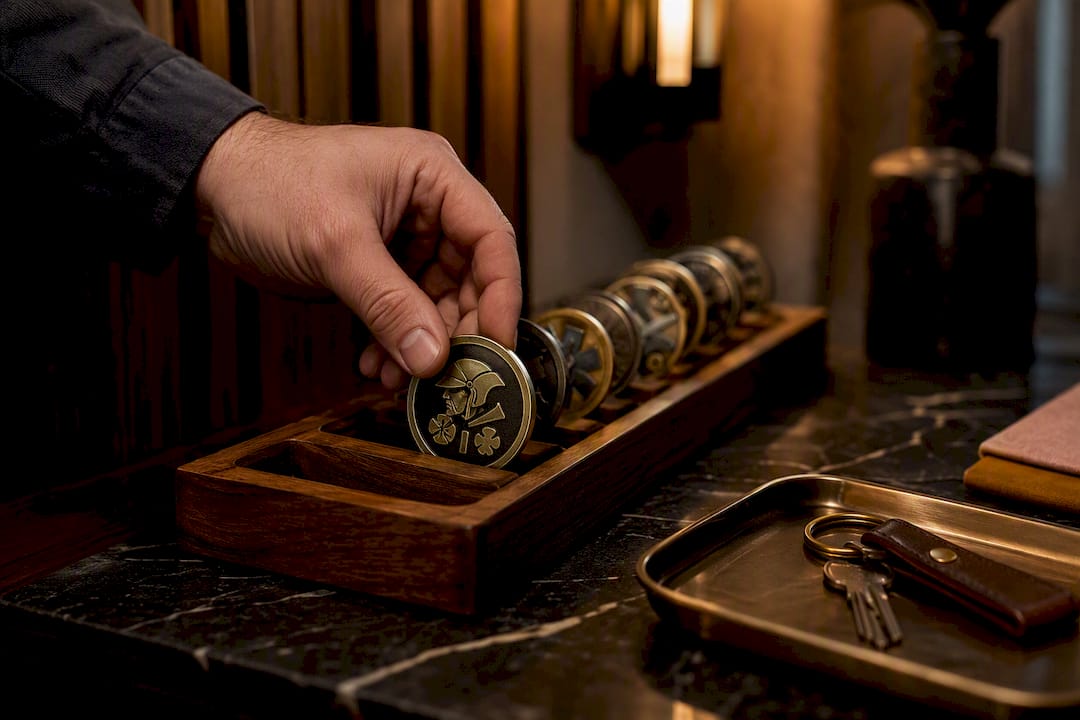
Carrying a coin daily means picking a method that survives your actual routine, not just looks good in theory. A wallet slot works if you never carry cash loose. A small capsule case protects the coin’s finish but adds bulk. A lanyard or pouch keeps it accessible for fast checks, though it’s the easiest option to lose track of during a shift change.
Display and care come down to a short list of habits:
- Use a case, shadowbox, or dedicated display stand rather than a drawer, where coins scratch against each other and lose their edge.
- Label each coin with its origin and date if you’re building a real collection. Memory fades faster than you’d think once you own more than a handful.
- Clean coins with a soft cloth only. Skip harsh polish or abrasive cleaners that strip the finish and dull the detail.
- Keep a photo of your coin as a backup memory, not as a substitute. A picture doesn’t count during a check, and it never will.
If you’re serious about preserving what you’ve earned, Brass & Bunker Co’s display idea guide walks through case styles and labeling approaches built for collectors who want their coins to outlast the moment they were given.
When Is It Wrong to Call a Challenge Coin Check?
Timing and setting matter more than most people realize. A challenge that lands well at a retirement dinner falls flat, or worse, insulting, in the wrong context.
- Skip it at funerals, memorials, or any solemn ceremony. These moments call for stillness, not stakes.
- Skip it during active emergencies or on-duty response. Coin checks belong to downtime, not to a scene.
- Skip it in restrooms. It’s an old rule, and it still holds.
- Check your workplace policy before running checks in professional settings. Some departments and agencies restrict the custom during official hours regardless of tradition.
Red flags to watch for include using a check to humiliate someone publicly or pressuring a non-drinker into an alcohol-based penalty. Coffee, a lunch tab, or a contribution to a unit fund work as well as a round of drinks and keep the custom inclusive for anyone who doesn’t drink.
Do Challenge Coin Rules Vary by Unit or Group?
Yes, significantly. One department might require a full reach and three steps; another sticks to a strict one step, no exceptions. Some units treat a commander’s coin as untouchable in a check, exempt by rank. None of it is universal law.
Before you assume you know the rules in a new group, ask these five questions:
- What counts as a valid trigger for a check (slam, call, raised coin)?
- How much time or how many steps do we allow?
- Are there coins or ranks that are exempt from checks?
- What’s the standard penalty, and is there a non-alcoholic alternative?
- Are there settings where checks are off limits here specifically?
Ask a few people of different rank or tenure for their version of the rules, then confirm with a group leader and write it down. A short onboarding note saves every new member from an awkward first check.
Where Does This Guidance Come From?
Etiquette this specific doesn’t come from guesswork. It comes from decades of shared custom passed between units, refined every time someone got a rule wrong in front of the wrong crowd.
- Brass & Bunker Co’s history of the challenge coin traces the tradition’s roots and explains why the custom carries the weight it does today.
- The display idea post gives collectors and organizers a practical next step once they understand the rules.
- Brass & Bunker Co was founded by a firefighter and a product designer, and that first responder heritage is exactly why the etiquette in this guide leans practical over ceremonial. Coins mean something specific in this community. Getting the rules right matters.
Why Etiquette Still Matters More Than the Coin Itself
Traditions like the coin check aren’t relics. They build morale and give people a fast, physical way to recognize each other across ranks and units. Etiquette is what keeps that recognition meaningful instead of turning into a party trick or a way to embarrass someone new.
Treat your coin as a token of service, not a trophy to flex. The rules exist to protect what the coin represents, and that’s worth more than winning a round.
— Brass & Bunker Co
Wear the Same Respect You Carry in Your Coin
Brass & Bunker Co isn’t in the coin business, but the same principle drives everything on the rack: heritage over hype, built to last, made for people who earned what they carry. If you’re already thinking about how to honor your service or a fellow first responder’s, apparel is a natural next step alongside a coin or a display case.

The Firefighter Apparel collection and the logo hat both work as pairings for a coin presentation, gear that means something on its own and holds up the way a good tradition should. Looking for a full gift beyond apparel? The veteran gift ideas guide covers pairings that go past a t shirt. Browse the hats collection or hoodies and jackets to find something built for daily wear, not just a shelf.
Sources
- The Rules of the Coin Check: Military Protocol Guide | KidderCorp
- The 5 “Official” Rules of a “Coin Check” – Signature Coins
- Challenge Coin Rules | Embleholics
- Challenge Coin Rules: Etiquette & Traditions | Monterey Company
FAQ
What Does It Mean When Someone Gives You Their Challenge Coin?
It means they’re recognizing your service, an achievement, or your membership in a group that matters to them. It’s a personal gesture, not a casual handout, and it deserves a genuine acknowledgment in return.
Can a Civilian Carry a Challenge Coin?
Yes. Civilians who receive a coin as a gift can carry and display it, though they should understand it still carries meaning tied to the group or person who gave it.
What Are the Rules of a Challenge Coin Check?
The core rule is producing your actual coin within your group’s allowed time or steps, typically one step and a reach, or covering the agreed penalty if you can’t. Photos and replicas don’t count, and local rules can vary from that standard.
Is Getting a Challenge Coin a Big Deal?
Yes, within the community that gives it. A challenge coin represents recognition earned through service or achievement, and treating it with the etiquette outlined here honors what it stands for rather than just its novelty.

