

Thin Green Line Meaning: Who It Honors and How to Display It
Sep 11, 2026
The Thin Green Line stands for the military personnel, Border Patrol agents, park rangers, and conservation officers who guard the country’s borders, wild lands, and federal interests. Like its predecessor, the thin blue line, it signals that a small, often overlooked group stands between order and chaos. But its meaning bends depending on who’s flying it and where, so the context around the symbol matters as much as the symbol itself.
TL;DR:
- The thin green line primarily honors military service members, veterans, and federal land and border agency personnel, often used in memorials and official ceremonies.
- Variations in green shades and backgrounds can cause confusion, making physical comparison the best way to verify authenticity.
- The symbol’s meaning has expanded from specific military and federal agency recognition to casual patriotism and outdoor branding, diluting its original intent.
- Context and setting are essential for interpreting the symbol correctly, especially distinguishing between tribute use and lifestyle or political displays.
- International use of the green line symbol usually applies to different institutions and lacks the specific American flag format, requiring explanation outside the US.
Table of Contents
- Thin Green Line Meaning: Who the Symbol Actually Represents
- What the Thin Green Line Flag Looks Like
- Where the Thin Line Symbolism Started
- Why the Meaning Shifts Depending on Who’s Using It
- How to Display the Thin Green Line Without Missing the Mark
- Thin Green Line vs. Blue, Red, and White: A Quick Comparison
- Notable Moments That Put the Thin Green Line in the Spotlight
- What the Symbol Means to the Communities That Carry It
- How US and International Audiences Read the Symbol Differently
- Why This Symbol Matters to Us
- Sources
- FAQ
Thin Green Line Meaning: Who the Symbol Actually Represents
The core claim behind the thin green line is straightforward: a small number of people hold a line most of us never think about. Two groups anchor that claim most consistently.
The military thin green line reading honors soldiers, veterans, and federal-level service members generally, tying the color to Army heritage and the broader idea of national defense. The second, equally common association points to federal agents charged with protecting land and borders. That includes Border Patrol officers, park rangers, and conservation officers. Some sources sharpen the reading even further into environmental-protection work specifically, framing the green stripe as a nod to the people who guard forests, wildlife, and natural resources rather than city streets.
Beyond those two anchors, the symbol drifts into contested territory. You’ll occasionally see it claimed by EMS crews or other first responders, though that usage is far less established and tends to show up more in casual apparel than in official department contexts. A park ranger wearing a thin green line patch on a duty uniform is making a very different statement than a hunter flying the flag from a truck bed, even though both are using the exact same image.
A few patterns show up again and again:
- Military and veteran communities use it as a general marker of service and sacrifice.
- Border Patrol and federal land agencies use it as a profession-specific badge of pride.
- Conservation and wildlife officers use it to mark work that rarely gets public recognition.
- Casual and retail use has stretched the symbol toward anyone who wants to signal outdoor or patriotic identity.
What the Thin Green Line Flag Looks Like
The standard design keeps things simple: a black-and-white American flag, stripes rendered in grayscale, with a single horizontal green stripe replacing one of the center white bars. It’s the same visual formula as the thin blue line and thin red line flags, just swapping in a different color for a different group.
Subdued variants exist too, and they’re where things get visually confusing. Some versions shift the background from stark black and white toward muted gray tones, and the shade of green itself varies from a bright forest tone to something closer to olive or army drab. Flag reference specialists note that photography and printing can distort how these colors read on screen or on fabric, making a genuinely black background look lighter gray in one photo and darker in another.
Quick identification checklist:
- Grayscale flag base with one green horizontal stripe
- Subdued or muted color schemes on tactical-style gear
- Green shade ranging from bright to olive/drab depending on print quality
- Common formats: flags, embroidered patches, vinyl decals, and printed apparel
One useful data point for spotting fakes or misprints: the same flag design, photographed under different lighting, can appear to have a completely different background tone even though the underlying artwork never changed. If you’re trying to match a patch to an official design, compare against a physical sample rather than relying on a single online image.
Where the Thin Line Symbolism Started
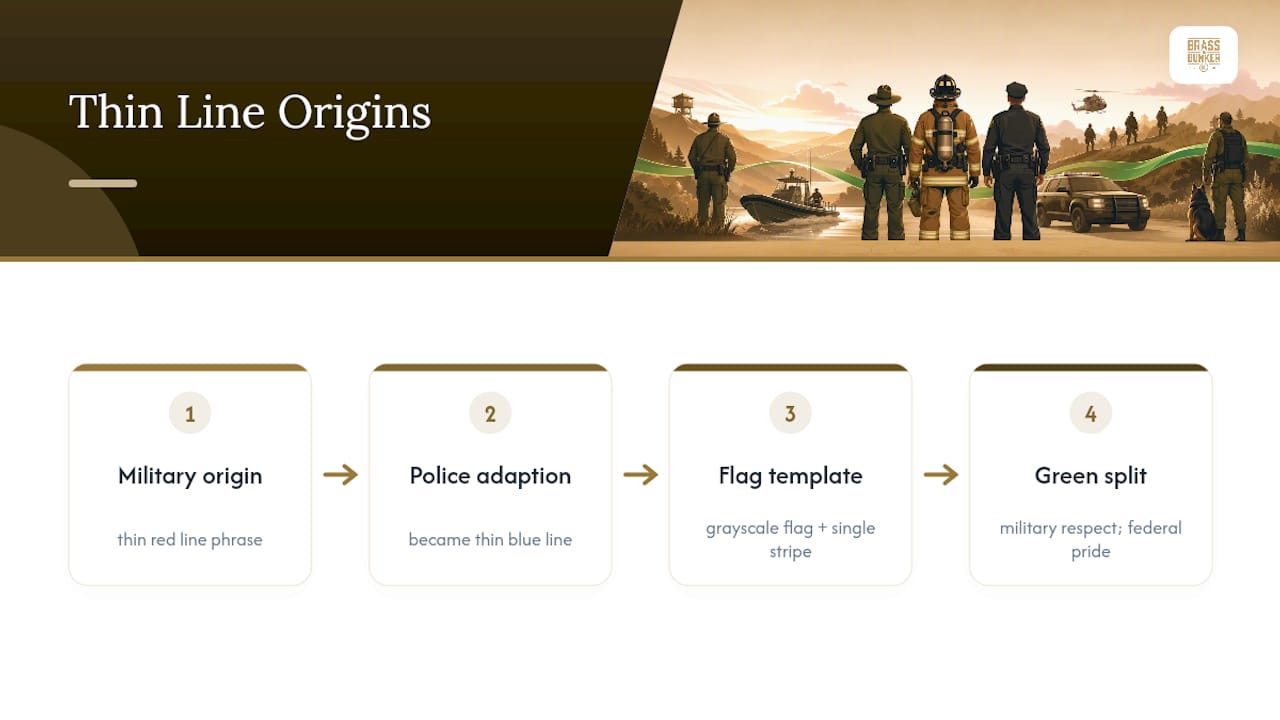
The “thin line” metaphor didn’t start with colors at all. It traces back to military language describing a small, undermanned unit holding a critical position against overwhelming odds, a “thin red line” of infantry standing firm when reinforcements were nowhere in sight.
That military phrase migrated into American law enforcement culture decades later, becoming the thin blue line: a symbol for police standing between civil society and disorder. Once the format proved popular, adopting a grayscale flag with a single colored stripe, other professions began adapting it for their own purposes.
Green entered the picture later, layered onto the same visual template but pointed at a different audience. Military and veteran groups embraced it as a service marker, while federal land and border agencies picked it up almost simultaneously as a way to represent work that rarely gets the same public attention as policing or firefighting. The overlap wasn’t planned. It happened because the thin-line format is flexible enough that almost any profession working a dangerous, thankless job could plausibly claim a color.
By the time the green variant reached wide circulation through merchandise and retail channels, its meaning had already split into the two main branches readers encounter today: broad military respect and specific federal-agency pride.
Why the Meaning Shifts Depending on Who’s Using It
Symbols dilute when too many groups adopt the same design, and the thin green line is a clear case of that happening in real time. What started as a fairly specific tribute to military service or federal land agents has stretched to cover EMS workers, general patriotism, and outdoor lifestyle branding, sometimes all in the same online store.
That dilution feeds real controversy. Thin-line flags in general have drawn criticism for looking politically charged even when the wearer intends only professional pride, and the thin blue line faced this most directly, with some critics reading it as a statement against police accountability movements rather than a tribute to fallen officers. Green hasn’t attracted the same level of scrutiny, but it sits close enough to that broader thin-line family that it can get swept into the same debate by association.
A few context clues help you read intent accurately:
- Flags displayed at memorials, funerals, or agency ceremonies almost always carry the tribute meaning.
- Flags paired with hunting, camping, or general outdoor gear often lean toward lifestyle branding rather than a specific tribute.
- Flags shown alongside overtly political messaging should be read as making a political statement, regardless of the wearer’s stated intent.
Pro Tip: If you’re unsure what someone means by displaying the thin green line, look at the company or context surrounding it. A park service fundraiser and a political rally send very different signals with the exact same flag.
How to Display the Thin Green Line Without Missing the Mark
Respectful use comes down to reading the room before you fly the flag or wear the patch. Here’s how to keep the tribute intact.
- Match the setting to the symbol. Memorial services, veteran fundraisers, and agency ceremonies are the safest, clearest contexts for display.
- Give credit where it’s due. If you’re honoring a specific group, say so, whether that’s a caption, a patch placement, or a conversation. Ambiguity is what breeds misreadings.
- Skip the political pairing. Displaying the flag alongside campaign material or protest signage shifts it from tribute to statement, whether you intend that or not.
- Choose apparel over confrontation. A well-made shirt or hat at a family gathering communicates pride without the same risk of misinterpretation as a flag flown in a contested public space.
- When in doubt, go specific. A design naming the exact agency or branch, rather than a generic green stripe, removes most of the ambiguity altogether. Our guide to respectful memorial shirt design covers this same principle in more detail for anyone planning a tribute piece.
Thin Green Line vs. Blue, Red, and White: A Quick Comparison
Color tells you almost everything about intended audience once you know the code.
- Thin red line: Firefighters, tracing back to military infantry formations before crossing into fire service tradition.
- Thin white line: EMS and dispatch personnel, a newer addition covered in our piece on the thin white line’s meaning.
- Thin green line: Military service broadly, plus Border Patrol, park rangers, and conservation officers specifically.
Green is the one variant that splits cleanly between a general military tribute and a narrower federal-agency identity, which is why context does more work here than with blue or red.
Notable Moments That Put the Thin Green Line in the Spotlight
The symbol has shown up consistently at Border Patrol memorial events, where agencies use the flag to honor agents killed in the line of duty along the southern and northern borders. Park service tribute pages and conservation officer memorials have adopted the same visual language, often pairing the flag with agency-specific insignia to make the tribute unmistakable.
Veteran-focused fundraisers and Army heritage events have leaned on the green stripe as well, usually alongside broader military tribute imagery rather than as a standalone symbol. These events tend to draw far less national media attention than police or fire tributes, which is part of why the thin green line hasn’t developed the same public profile as its blue counterpart.
Retail and merchandise moments matter here too, in a less ceremonial but still influential way, with items like the Gulf of America Hat Embroidered Patch Mesh Back Trucker Hat helping spread the symbol’s visibility. Patches, decals, and apparel sold through outdoor and tactical gear retailers have pushed the symbol into casual, everyday visibility, appearing on trucks, hats, and gear bags far more often than on an official flagpole. That commercial spread has done as much to shape public recognition of the green stripe as any single memorial event, for better or worse.
What the Symbol Means to the Communities That Carry It
Inside Border Patrol, conservation, and park ranger circles, the thin green line functions less as a public statement and more as an internal marker of shared hardship. These are professions that operate largely out of public view, patrolling remote borders or vast stretches of wilderness where recognition is rare and danger is real. The flag gives agents and officers a shorthand way to say “I understand what this job costs” to each other, even when the broader public barely registers what they do.
Military and veteran communities carry a slightly different weight with the same symbol. For them, it often connects to Army-specific heritage and a general sense of service recognition that spans branches and generations, less about a single job’s daily risks and more about a lifetime commitment to the uniform.
That difference in emotional register, immediate occupational hazard on one side, lifelong service identity on the other, is exactly why the symbol resists a single clean definition. Communities that adopt it are reaching for connection and recognition, not branding consistency, and that’s a distinction worth sitting with the next time you see the flag on someone’s porch or vehicle.
How US and International Audiences Read the Symbol Differently
The thin green line is, at its core, an American symbol, built from American flag imagery and tied to distinctly American federal agencies like Border Patrol and the National Park Service. That origin means the symbolism doesn’t automatically translate outside U.S. borders the way some universal tribute colors do.
Where green-line symbolism appears internationally, it tends to attach to different institutions entirely, sometimes gamekeepers, forestry officers, or environmental agencies in countries with their own conservation traditions, borrowing the color concept without the specific American flag format. The visual language gets adapted rather than copied wholesale.
Within the United States, the flag format itself, monochrome stars and stripes with a single colored bar, carries specific cultural weight tied to the broader thin-line movement that started with police and firefighters. That shared visual grammar is largely absent internationally, which means a green-striped flag shown to a non-American audience may communicate almost nothing without additional context. If you’re using the symbol to connect with an international audience, expect to explain it rather than assume recognition.
Why This Symbol Matters to Us
The company was founded with the understanding that symbols carry weight only when the people wearing them understand what’s behind the image. We dug into the thin green line’s history because accuracy matters, especially for federal agents and military families who see their service reduced to a trend on a hat rack. Solidarity built on a real understanding of the symbol outlasts solidarity built on a logo alone. If you’re looking to honor that service with gear built to hold up the same way the people it represents do, our firefighter apparel collection reflects the same commitment to craftsmanship over trend.
— Brass & Bunker Co
Sources
- American Flag with Green Stripe Meaning: Thin Green Line 2026 – Operation Military Kids
- Thin Green Line Flag description – CRW Flags / FOTW
- Thin Green Line: What Is It and What Does It Mean? – USAMM
FAQ
Is “Don’t Tread on Me” Political?
The Gadsden flag’s “Don’t Tread on Me” slogan started as a Revolutionary War symbol of resistance to British rule, but it’s been adopted by various modern political movements, making its meaning highly context-dependent today.
What Does the U.S. Flag With a Thin Green Line Mean?
It most commonly honors military personnel and veterans, and it’s also used to represent federal agents like Border Patrol officers, park rangers, and conservation officers.
Why Is the Thin Blue Line Flag Controversial?
Some critics view it as a statement against police accountability movements, while supporters see it strictly as a tribute to officers killed or injured in the line of duty; the split in interpretation is what fuels ongoing debate.
What Color Is the Thin Line for Nurses and EMS Personnel?
EMS and dispatch personnel are generally represented by the thin white line, a newer addition to the thin-line family that developed alongside the more established blue and red variants.
Does the Thin Green Line Always Mean the Same Thing?
No. Its meaning shifts based on context, sometimes signaling broad military respect and other times pointing specifically to federal land and border agencies, so surrounding details matter more than the color alone.

