

5 Tagless T Shirt Benefits Brands and Shoppers Need to Know
Sep 15, 2026
Yes. Tagless t-shirts reduce neck irritation, cut labeling costs, and give brands more room to design clear, legible branding on the inside collar. Durability is the one variable that shifts case by case, since it depends entirely on the printing method a manufacturer chooses and how well that ink bonds to the fabric.
TL;DR:
- Tagless printing speeds up production by eliminating sourcing, sewing, and inventory management for separate tags, which reduces manufacturing errors.
- Ink durability depends on the printing method, with pad printing offering the best resistance to repeated wash cycles and stretching.
- Producing tagless labels remains cost-effective for large-volume orders, as the initial investment in pad printers pays off with per-unit savings over sewn labels.
- Printed labels allow for larger, clearer branding and care instructions, which can enhance product perception and functionality compared to traditional sewn tags.
- While tagless construction reduces fabric waste and simplifies recycling, brands should verify wash-test durability and environmental claims rather than assuming inherent sustainability.
Table of Contents
- Tagless T-Shirts Benefits: Five Quick Wins Worth Knowing
- Why Tagless Construction Feels Better Against the Skin
- How Tagless Labeling Speeds Up the Production Line
- What Tagless Labels Actually Cost to Produce
- Pad Printing, Heat-Transfer, and Screen Printing Compared
- How Long Tagless Labels Actually Last
- Branding and Design Room Tagless Labels Unlock
- The Environmental Case for Skipping the Tag
- Why Brass & Bunker Co. Builds Tees With Tagless Construction
- Check Out Tagless Tees Built for the Long Haul
- Sources
- FAQ
Tagless T-Shirts Benefits: Five Quick Wins Worth Knowing
Before getting into the mechanics, here’s the short version of why so many apparel makers, including crews who wear their gear daily on the job, have moved away from sewn-in tags:
- Comfort: No scratchy edge rubbing against the back of the neck all shift long.
- Faster production: Fewer assembly steps because there is no separate tag to source, cut, or stitch.
- Lower per-unit cost: Printed labels run pennies per garment compared to sourcing and sewing fabric tags.
- Better branding: Larger, sharper text fits where a folded tag used to cram tiny print.
- Less waste: No leftover tag material, thread scraps, or adhesive backing headed to the landfill.
Each of these deserves a closer look, especially for anyone weighing whether tagless construction is worth building into a product line or worth paying attention to as a shopper.
Why Tagless Construction Feels Better Against the Skin
A sewn tag is a folded, stitched layer of fabric sitting right against one of the most sensitive strips of skin on the body, the back of the neck. Every seam, every stitch pucker, becomes a friction point that rubs with each turn of the head. Printed labels remove that contact point entirely by putting ink directly onto the shirt’s existing fabric instead of adding a foreign material.
Trade reporting on the shift toward tagless technology found that woven tags bothered roughly two-thirds of consumers surveyed in brand research, which explains why so many manufacturers made the switch industry-wide rather than treating it as a niche feature. Children’s wear and activewear brands notice this most, since kids fidget at any irritation and athletes sweat, stretch, and move in ways that make a stiff tag unbearable over a long run or shift.
Fabric matters too. Cotton takes ink smoothly and holds it flat against the weave, while stretch synthetics and blends need ink that flexes with the material instead of cracking at the collar seam. When you’re shopping, check the product photos for ink texture and placement. A well-printed label should look flush against the fabric, not raised or peeling at the edges.
How Tagless Labeling Speeds Up the Production Line
Sewn tags require a manufacturer to source a separate material, warehouse it as its own SKU, and run it through an extra sewing station before the shirt is finished. Cut any one of those steps and the whole line moves faster. Printed tagless labels eliminate the sourcing, storage, and sewing steps entirely, which simplifies inventory and reduces the number of places where a defect can creep in.
Throughput gains back that up. Supplier data on pad-print setups shows machines capable of printing hundreds to thousands of parts per hour, and because the ink dries almost instantly, there’s no cooling or curing bottleneck slowing the next shirt down the line. Sewn tags, by contrast, introduce a manual step that’s prone to crooked stitching, skipped tags, or misaligned placement, all of which show up as returns later.
For manufacturers deciding between in-house printing and outsourcing, volume is the deciding factor, as seen with retail examples like the Purpose Printed Faith Comfort Tee – Bold Faith Apparel that highlight comfort-focused printed labels. High-volume runs typically justify owning the equipment; smaller or highly seasonal runs often make more sense through a contract printer who already has the machines calibrated.
What Tagless Labels Actually Cost to Produce
The economics favor tagless once volume climbs past a modest threshold. Supplier materials put pad-printing supply costs as low as a few thousandths of a dollar per label, a figure that’s hard to match with a sewn fabric tag once you account for the material itself, the thread, and the labor minutes spent feeding it through a sewing station.
The bigger consideration for manufacturers is capital versus operating cost. A single-color pad printer is a one-time investment, and entry-level units are priced modestly enough that smaller shops can justify the purchase, with ink cartridges yielding a high number of impressions before replacement. Sewn labeling has almost no upfront machine cost but carries a steady, recurring labor and material expense on every single unit produced.
A simple way to think about break-even: divide the machine cost by the per-unit savings versus sewing, and you’ll usually find the payback period shortens fast at anything beyond small-batch production. Custom, short runs with frequent design changes are the one place sewn tags or outsourced printing can still make more financial sense, since machine setup and screen changes eat into the savings on tiny quantities.
Pad Printing, Heat-Transfer, and Screen Printing Compared
Not all tagless methods perform the same way, and the choice affects both feel and lifespan.
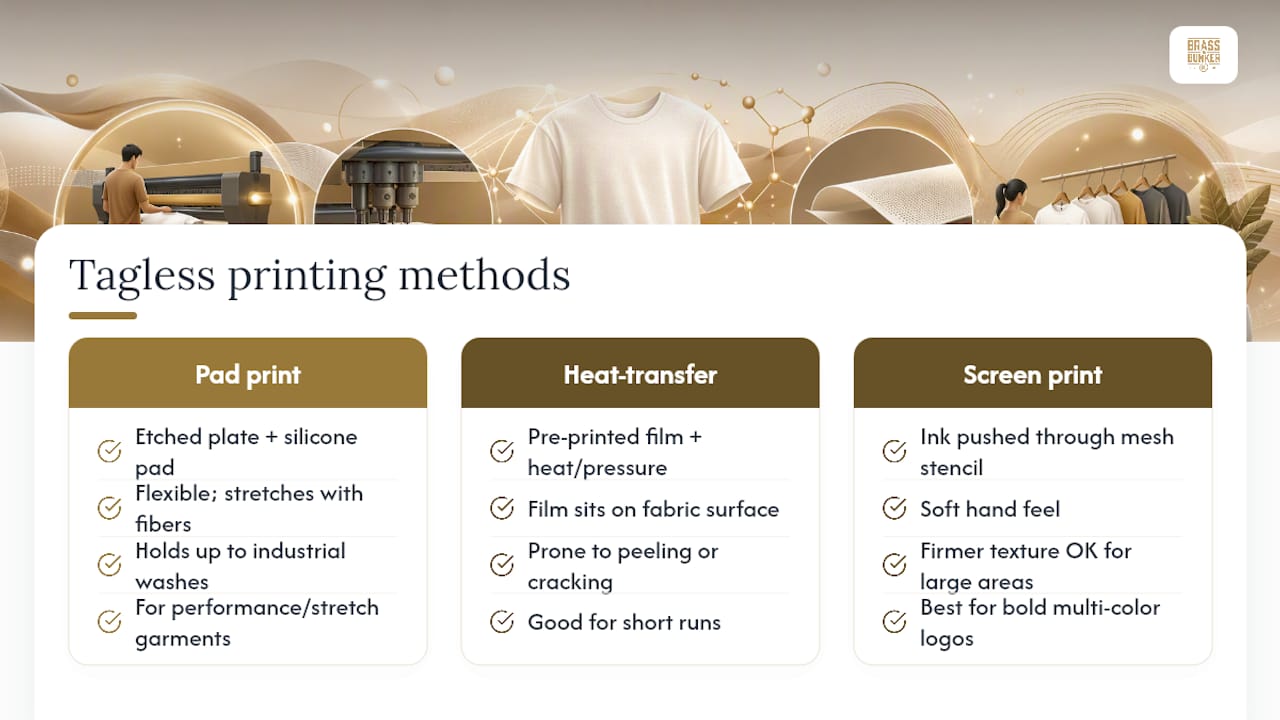
Pad printing transfers ink from an etched plate onto fabric using a flexible silicone pad, which lets the ink move and stretch with the fibers underneath it. That flexibility is why pad printing holds up well through repeated industrial wash cycles and why it’s the common choice for performance and stretch garments where a stiffer label would crack.
Heat-transfer printing applies a pre-printed film using heat and pressure. It’s fast and works well for short runs, but lower-quality films sit on top of the fabric rather than bonding into it, making them more prone to peeling or cracking after heavy washing or repeated flexing at the collar.
Screen printing pushes ink through a mesh stencil and produces a soft hand feel, making it a strong option for larger label areas where a firmer texture is acceptable. It’s less common for fine text but excels at bold, multi-color logos.
How Long Tagless Labels Actually Last
Durability tracks directly to ink chemistry. Pad printing embeds ink into the fabric fibers themselves, while some heat-transfer films sit on top of the material and are more vulnerable to cracking after dozens of wash and dry cycles, particularly around stretch seams.
For everyday care, washing in warm rather than hot water and skipping high-heat tumble drying extends any printed label’s life, tagless or otherwise. Manufacturers validate durability through repeated wash-cycle testing and abrasion tests before a label design goes to full production. If you’re a buyer evaluating a supplier, ask for those wash-test results directly. A supplier confident in their ink should have that data on hand.

Branding and Design Room Tagless Labels Unlock
A sewn tag limits designers to a narrow strip of folded fabric. Printed labels open up the entire inside collar, allowing larger text, cleaner icons, and far better legibility for care instructions and fiber content, details that actually matter when someone is checking wash settings at 6 a.m. before a shift.
Placement still affects comfort, so the print needs to sit flat against skin without a raised edge. Beyond function, tagless has become its own marketing point. Industry pages frame it as a marketable premium feature that signals attention to comfort and craftsmanship rather than just a cost-cutting shortcut.
The Environmental Case for Skipping the Tag
Cutting sewn tags out of production reduces the fabric, thread, and adhesive waste that comes with sourcing a separate material for every single shirt, and it simplifies recycling since there’s no extra fabric layer to strip out.
That said, printing isn’t waste-free either. Ink and consumables carry their own footprint, so brands making sustainability claims should document actual wash-test results and material use from their suppliers rather than assuming tagless is automatically greener. A modest, verified claim beats an inflated one every time.
Why Brass & Bunker Co. Builds Tees With Tagless Construction
Brass & Bunker Co. was built by a firefighter and a product designer, and that pairing shows up in how we think about gear meant to be worn hard, day after day, shift after shift. Comfort isn’t a marketing bullet point to us. It’s the difference between a shirt someone actually reaches for on a 24-hour rotation and one that ends up in the back of a drawer.
We favor tagless construction because it aligns with what durable, purpose-built apparel should deliver: no irritation at the collar, straightforward care instructions printed clear enough to read after a dozen washes, and label placement that doesn’t interfere with how a shirt fits under gear. When you’re comparing tagless tees on any product page, look past the marketing copy and check what the description actually says about ink method and wash care. That detail tells you more than the word “tagless” ever will.
— Brass & Bunker Co
Check Out Tagless Tees Built for the Long Haul
Tees built with principles of heritage over hype, and construction that holds up under real use. Tagless labeling is part of that approach, not a gimmick bolted on for a product listing.

Browse the full t-shirt collection to see how label method, ink feel, and care instructions show up on the product page itself, or take a closer look at the Built for the Brave Tee for a specific example of how we handle construction details. If you wear a badge, a set of turnout gear, or a uniform for a living, browse the firefighter apparel line built around the same standard. Check the product description before you buy, and you’ll know exactly what you’re putting on your back.
Sources
- Why Switch to Printed Garment Tags? | Inkcups
- Tagless Printing Machines | Engineered Printing Solutions
- Garment Makers Adopt Tagless Technology | California Apparel News
- The Essential Guide to Tagless Labels on Garments — RapidTag by ASPE
FAQ
What does tagless t-shirt mean?
A tagless t-shirt has its brand, size, and care information printed directly onto the fabric instead of sewn on as a separate cloth tag, removing the stitched edge that usually sits against the neck.
Why are white tees not allowed in clubs?
That’s a dress code issue tied to venue policy, not a tagless labeling question. Some venues restrict plain white tees for style or security reasons unrelated to how the garment is labeled.
What’s the healthiest fabric to wear?
Breathable natural fibers like cotton are widely favored for everyday comfort and skin tolerance, though the healthiest choice depends on activity level, climate, and individual sensitivity.
Why are people leaving tags on their clothes?
Some shoppers leave tags on for return flexibility or resale value, but that’s a separate habit from tagless construction, which removes the physical fabric tag from the garment altogether rather than just leaving a paper tag attached.
Are tagless t-shirts better than tagged ones?
For comfort, most wearers find tagless shirts noticeably better since there’s no stitched edge to irritate the neck. Durability comes down to the printing method, with pad printing generally outlasting lower-quality heat-transfer labels.

