

Two U.S. Flag Patch Orientations: Left Standard, Right Reversed
Sep 18, 2026
The rule is simple once you know it: on the left sleeve or over the heart, the flag patch faces the standard way, with the stars in the upper left corner from the viewer’s perspective. On the right sleeve, the patch reverses so the union still leads, as if the flag were flying forward as you move. Civilians unsure which to buy should default to the standard, left/over-heart version.
TL;DR:
- The reverse patch on the right sleeve is designed to depict the flag flying forward, as if carried by motion, with the union leading into the wind.
- Military guidance professionally standardizes the left sleeve with the flag’s union in the top left and the right sleeve reversed, but the Flag Code does not specify sleeve orientation.
- Civilians and civilian organizations typically use the standard orientation on the left chest or sleeve unless they follow specific military or organizational regulations.
- When designing or purchasing patches, ensure correct placement and orientation by testing on fabric to avoid disrespectful puckering or misaligned display.
- The reversed patch on the right shoulder is a recent military convention, not a reflection of legal requirement, and worldwide practices vary among allied forces.
Table of Contents
- Flag Patch Orientation: Left Sleeve Standard, Right Sleeve Reversed
- What the Flag Code Actually Regulates
- How to Place a Flag Patch on Sleeves, Chest, Hats, and Gear
- Flag Patch Etiquette: What to Avoid
- Brass & Bunker Co.'s Take on Placement and Durability
- How Flag Patch Orientation Evolved Over Time
- Flag Patch Orientation Around the World
- Correct vs. Incorrect Flag Patch Orientation, Explained
- Flag Patches for First Responders, Scouts, and Everyday Civilian Wear
- Explaining Reversed Patches Without the Argument
- Shop Flag-Patch Apparel Built to Honor It Correctly
- Sources
- FAQ
Flag Patch Orientation: Left Sleeve Standard, Right Sleeve Reversed
Every flag patch tells a story about direction, and the military has settled that story with two distinct patches instead of one. On the left shoulder, the patch reads exactly like a flag on a pole: the union, that blue field of stars, sits in the top left corner as you look at it. On the right shoulder, the same flag gets mirrored. The stars now sit in the top right corner, and the stripes trail backward toward the wearer’s back.
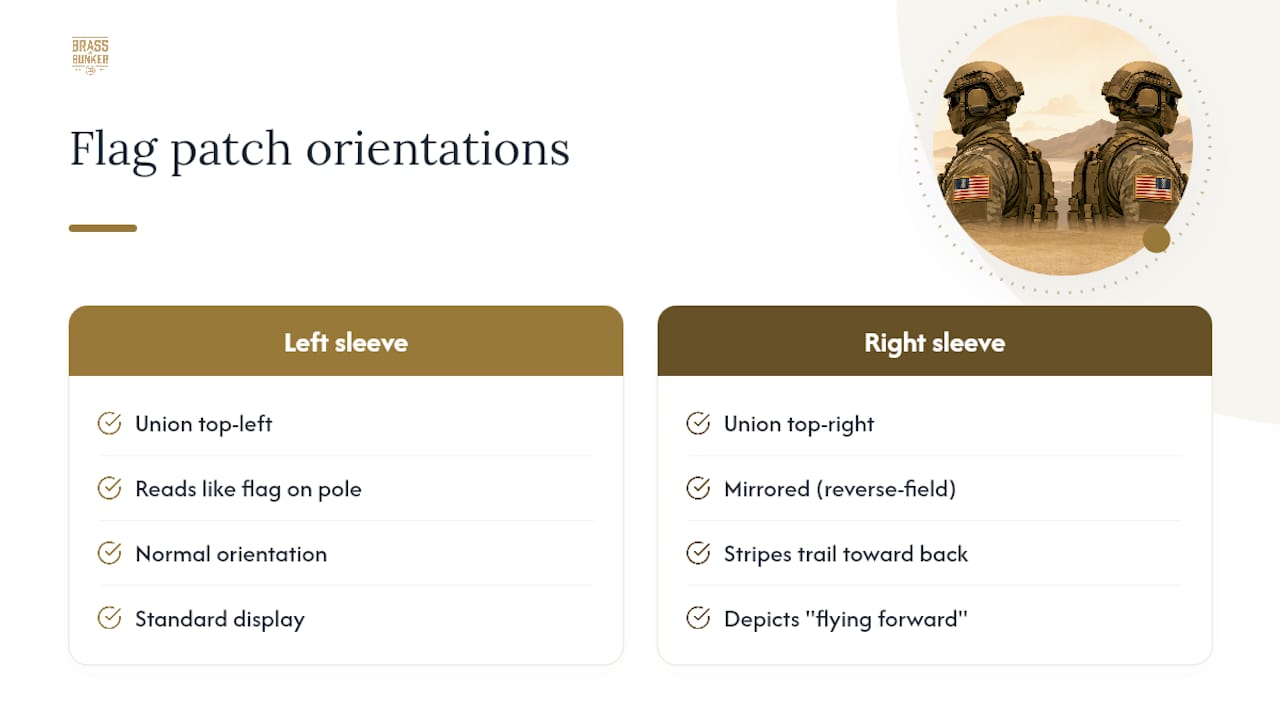
That mirroring isn’t a printing error. It represents an old military convention called “flying forward.” Picture a flag mounted on a pole attached to a moving vehicle or a marching soldier. The union, tethered to the staff, would always point into the wind created by forward motion, while the stripes trail behind. A reversed patch on the right shoulder recreates that same effect: the flag looks like it’s being carried into the advance, never retreating.
Army guidance authorizes both versions for exactly this reason, assigning the standard patch to the left sleeve and the reverse-field version to the right. As the Army flag insignia guidance lays out, this isn’t optional stylistic flair. It’s a codified part of uniform regulation. The North American Vexillological Association confirms the same logic in plain terms, explaining that the reversed patch depicts the flag as it would appear whipping in the wind while the wearer charges ahead.
“The flag is reversed on the right sleeve so it appears to be flying as the wearer moves forward, similar to how a flag would fly if mounted on a vehicle moving in that direction,” according to reporting on Army uniform practice from Stars and Stripes.
What the Flag Code Actually Regulates
Here’s where a lot of confusion starts. Readers assume federal law dictates exactly how a flag patch should sit on a sleeve. It doesn’t.
4 U.S.C. § 7 governs how the flag is displayed on walls, in parades, and alongside other flags, requiring the union to stay uppermost and to the flag’s own right, which appears as the observer’s left. That statute covers flat displays and hanging arrangements. It says nothing about sleeve patches, hat placement, or gear.
Quick fact: The Flag Code broadly discourages using the flag as clothing, yet it carves out a specific allowance for uniforms worn by military members, firefighters, police officers, and members of patriotic organizations, according to the VA’s flag display guidance.
That’s the gap most people miss. The Flag Code sets the tone for respect and clarifies who can legitimately wear flag insignia on a uniform. It never says which shoulder gets which orientation. That level of detail comes from the Army, from individual departments, or from organizational dress policy. When a fire department or a scout troop decides how their flag patch sits, they’re filling in a blank the federal statute intentionally left open.
How to Place a Flag Patch on Sleeves, Chest, Hats, and Gear
Placement comes down to a few dependable habits, whether you’re outfitting a duty uniform or picking a patch for a range bag.
Military sizing runs small and standardized. The Army’s flag insignia guidance specifies a patch of roughly 2 by 3 inches on utility uniforms, mounted on the shoulder pocket flap with the top of the patch aligned to the top of the hook-and-loop pad. That sizing translates well to civilian gear, since anything larger tends to overwhelm a sleeve or hat panel.
- Left sleeve or left chest: standard orientation, union toward the wearer’s front.
- Right sleeve: reverse-field patch, union still leading forward.
- Ball caps: standard orientation on the front panel, mimicking left-chest placement.
- Backpacks and range bags: standard orientation unless the item is worn or mirrored like a right sleeve.
- Tactical or deployed gear: subdued (muted olive or gray) patches instead of full color, to reduce visibility in the field.
Fabric choice affects how well any of this holds up. A patch stitched onto a stretchy or low-grade blend tends to pucker, and a puckered flag looks disrespectful even when the orientation is technically correct.
Pro Tip: Test the patch on a scrap of the actual garment fabric before committing to permanent stitching. Hook-and-loop backing lets you catch orientation mistakes before they become embarrassing and permanent.
Flag Patch Etiquette: What to Avoid
A few situations turn a well-intentioned flag patch into a real misstep. Keep these in mind before you attach one.
- Skip disposable or easily soiled items. Shoes, seat panels, and underwear are the classic examples the VFW’s etiquette guide flags as inappropriate for flag imagery.
- Never let a flag patch touch the ground, whether it’s on a jacket draped over a chair or a bag set down carelessly.
- Retire a worn, frayed, or damaged patch the same way you’d retire a worn flag, rather than continuing to display it in poor condition.
- When multiple patches share a garment, give the U.S. flag the highest position, above unit patches, morale patches, or logos.
- If you’re not sure which orientation applies to your situation, choose the standard left/over-heart version and follow whatever policy governs your service, department, or organization.
Our guide on flag apparel etiquette covers more edge cases if you’re outfitting a crew and want every garment to hold up to scrutiny.
Brass & Bunker Co.'s Take on Placement and Durability
The company was created on the idea that gear should hold up the way the people wearing it do, combining firsthand experience with a product designer’s expertise on durable materials.
That background shapes how we think about flag patches specifically. A patch needs seam clearance so stitching doesn’t warp the union’s shape, and hook-and-loop backing placed correctly so a patch doesn’t shift or tear loose during hard use. We match placement to garment type: chest-center on tees, shoulder panel on hoodies, front panel on hats, because a flag that’s stitched crooked or attached with weak thread stops being a tribute and starts being a liability. Materials matter here as much as orientation does, a lesson we carried over from our take on morale patch history and what these small pieces of fabric are meant to signal.
— Brass & Bunker Co
How Flag Patch Orientation Evolved Over Time
Flag patches on American uniforms weren’t always standardized the way they are now. Early 20th-century military units experimented with unit insignia and national symbols long before a consistent flag patch policy existed. World War II uniforms carried shoulder sleeve insignia identifying divisions and commands, but the flag itself wasn’t a routine addition to combat uniforms yet.
The modern flag patch, as most Americans picture it, gained real traction during the Vietnam era and expanded through the following decades as the Army formalized uniform regulations. The reverse-field patch for the right shoulder is a comparatively recent refinement, one that emerged as the Army codified the “flying forward” concept into official guidance rather than leaving it as informal tradition.
Civilian adoption followed a different path entirely. Fire departments, police agencies, and scouting organizations began adding flag patches to their own uniforms throughout the latter half of the 20th century, largely borrowing military conventions without necessarily adopting the reverse-patch nuance. Many civilian organizations still use a single standard orientation on both sleeves, since they aren’t bound by the same regulation that drives the Army’s two-patch system.
What’s stayed consistent is the underlying principle from the Flag Code: the union stays prominent, and the flag’s dignity comes before any stylistic preference. The orientation debate is really a modern refinement layered on top of a much older, simpler rule about respect.
Flag Patch Orientation Around the World
American practice isn’t universal, and that surprises a lot of people the first time they see a foreign uniform with a national flag patch that doesn’t mirror the way U.S. Army sleeves do.
Many NATO allies use a single, non-reversed flag patch on both shoulders, treating the flag as a fixed identifier rather than a symbol of directional motion. The forward-flying convention that drives the American reverse patch is not a universal military design principle. It’s a specific interpretation the U.S. Army adopted and formalized, and other nations were free to take a different approach or skip the concept altogether.
Some countries emphasize unit or branch insignia over national flag patches entirely, reserving flag display for dress uniforms or ceremonial contexts rather than daily combat or duty wear. Others place the national flag patch on the chest instead of the shoulder, sidestepping the left/right orientation question altogether.
The variation matters for one practical reason: it shows that flag patch orientation isn’t dictated by some universal law of flag physics. It’s a design choice built on a specific storytelling convention, one the U.S. military chose to formalize while plenty of allied and international forces chose different symbolism or none at all. When Americans encounter a differently oriented patch from another country’s uniform, it’s not a violation of anything. It’s simply a different national convention doing the same basic job: identifying who someone serves.
Correct vs. Incorrect Flag Patch Orientation, Explained
Picture two shoulders side by side. On the left sleeve, the patch shows stars in the top left corner, red and white stripes running to the right, exactly like a flag hanging flat against a wall. That’s standard orientation, and it’s correct on the left sleeve, on hats, and on chest placement.
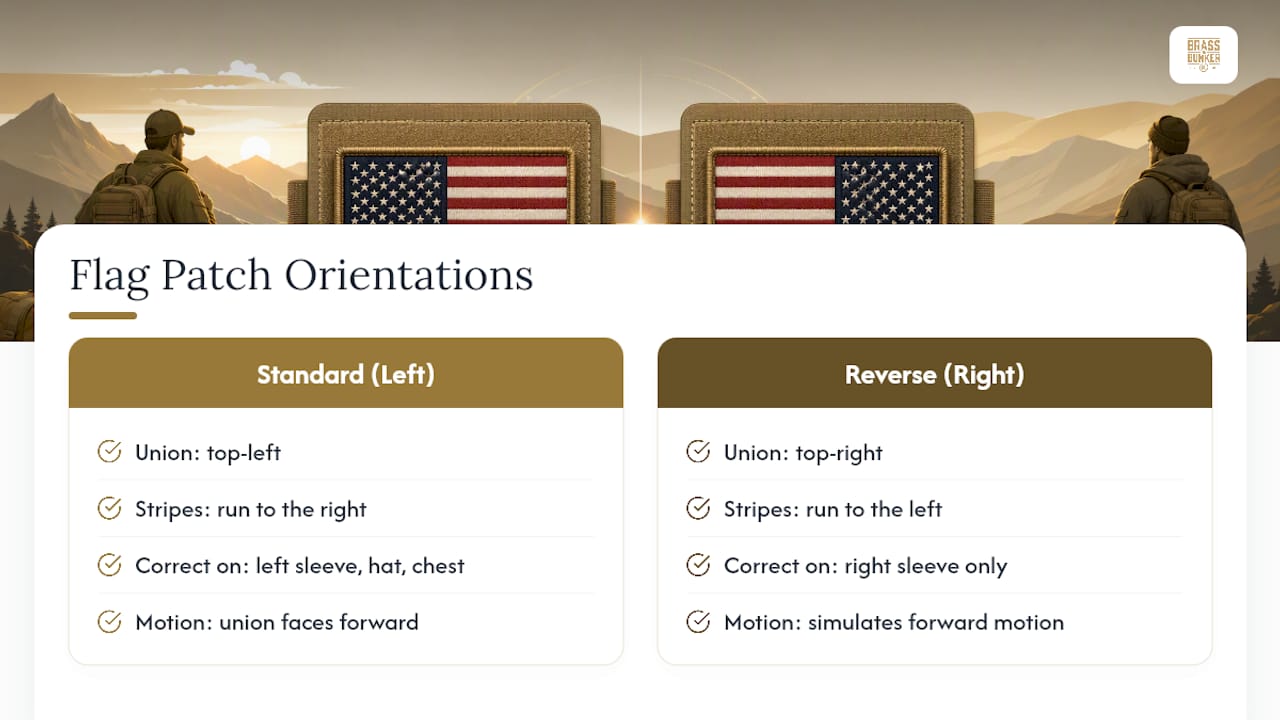
Now picture the right sleeve. The stars have moved to the top right corner, and the stripes now run to the left. That’s the reverse patch, and it’s correct only on the right sleeve, precisely because it simulates forward motion.
The mistake happens when someone uses the standard patch on the right sleeve, or the reverse patch on the left. Both errors are common among people ordering patches without realizing two distinct versions exist. A standard patch on the right shoulder looks like the flag is retreating rather than advancing, since the union trails backward instead of leading. A reverse patch on the left sleeve creates the mirror-image problem: the union appears to point away from the body instead of toward it.
If you’re shopping for patches and only one option is listed, check carefully whether it’s labeled “standard” or “reverse” before assuming it fits both sleeves. Reputable embroiderers, including partners like Lee Embroidery, typically offer both versions specifically because retailers know this mismatch trips people up constantly.
Flag Patches for First Responders, Scouts, and Everyday Civilian Wear
Civilians don’t answer to Army regulation, but that doesn’t mean orientation is a free-for-all. Fire departments, police agencies, EMS units, and scouting organizations each set their own uniform policy, and most default to the simpler standard orientation on both sleeves rather than adopting the military’s dual-patch system.
If you’re outfitting a civilian uniform or ordering patches for a crew, the safest call is standard orientation on the left chest or left sleeve, matching the way the flag reads on a flat display. That’s consistent with the practical guidance most veteran and etiquette organizations recommend when no formal dual-patch policy exists. Scout troops in particular tend to follow this simpler convention, treating the flag patch as an identifier rather than a symbolic nod to forward motion.
For everyday apparel like tees, hoodies, or hats, the same logic applies: pick the standard orientation unless you’re specifically replicating a military-style right-sleeve look. When in doubt, over-heart placement with the standard patch satisfies both the spirit of the Flag Code and general public expectation. It’s the version people recognize instantly, and it avoids the “is that backward?” question altogether. If you want to build a uniform policy from scratch for a department or troop, borrowing the Army’s clarity, one orientation per sleeve, clearly documented, saves confusion down the line.
Explaining Reversed Patches Without the Argument
Reverse patches confuse people who’ve never seen the right-sleeve version before, and that’s a fair reaction. Most folks have only seen the standard flag orientation their whole lives, so a mirrored version reads as a mistake rather than a design choice.
The simplest explanation, one that defuses most pushback fast: “The flag’s reversed on that side so it looks like it’s flying forward as the person moves, not backward.” That’s it. No lecture needed.
Formal ceremonies (color guard, funerals, retirement flag folding) follow strict Flag Code display rules, not sleeve-patch conventions, so don’t conflate the two when someone raises a ceremony-based objection. Informal daily wear has more flexibility, and that’s exactly where department or unit policy should be your final word.
Shop Flag-Patch Apparel Built to Honor It Correctly
Brass & Bunker Co. focuses on offering gear that honors the flag and meets higher standards of durability and respectful display compared to generic options.

Our Firefighter Apparel collection features garments built around correct, durable flag placement rather than an afterthought print job. If you want something simpler to start, browse the tee collection for left-chest orientation done right, or check out the hats for a front-panel flag that won’t warp after a season of wear. Every piece reflects the same craftsmanship-over-hype approach we’ve built the brand on since day one, made by people who’ve worn the gear that matters.
Customers with custom placement requests or questions about flag patch orientation policies can contact the company’s support team for assistance.
Sources
- 4 U.S.C. § 7 — Position and manner of display
- U.S. flag insignia placement and DA PAM guidance (AR670 references)
- NAVA Q&A on flag shoulder patch orientation
- Is the flag ‘backwards’ on soldiers’ sleeves? | Stars and Stripes
FAQ
Does the flag patch go on the left or right shoulder?
Both, but they’re oriented differently. The left shoulder gets the standard patch with the union in the top left corner, while the right shoulder gets a reverse patch with the union in the top right corner, following Army flag insignia guidance.
Which way should an American flag patch face?
On the left sleeve or chest, the union faces the standard way, matching a flag hung flat against a wall. On the right sleeve, the patch reverses so the union appears to lead the flag forward as the wearer moves.
Should the flag face left or right on a front door display?
Federal guidance under 4 U.S.C. § 7 applies to flat and hanging displays, not sleeve patches. It requires the union to stay uppermost and to the flag’s own right, which appears as the observer’s left when viewed from outside.
Why is the Army flag patch reversed on the right sleeve?
The reversal simulates a flag flying forward, as if mounted on a staff moving into the wind created by advancing motion. NAVA and Stars and Stripes both confirm this is intentional, sanctioned uniform practice, not a printing error.
Does Brass & Bunker Co. sell flag-patch apparel with correct orientation?
Yes. The Firefighter Apparel collection and other product lines feature flag placement built for standard left-chest orientation, with current pricing and options available directly on the site.

