

6 Challenge Coin Display Ideas Collectors Should Build or Buy
Sep 14, 2026
The best challenge coin displays fall into six formats: desk racks, shadow boxes, wall cabinets, acrylic capsules, floating frames, and rotating stands. Small collections do best in a tiered wooden rack or a single floating frame; large collections need a wall cabinet or modular shadow box system that can grow with you. Whatever you choose, keep coins out of direct sunlight and back them with acid-free material to stop tarnish before it starts.
TL;DR:
- Shadow boxes are ideal for storytelling displays that combine coins with memorabilia, patches, and photos to highlight specific events or careers.
- Large collections benefit from wall cabinets or modular shadow boxes, which provide space for expansion while maintaining organization and protection.
- Building a custom rack requires precise angles around 14 degrees, consistent slot depth, and spacing of about one inch to securely hold varying coin thicknesses.
- Protecting coins involves using acid-free backing, indirect LED lighting, and avoiding adhesives or permanent magnets to preserve surface condition over time.
- For small collections, a simple tiered rack or floating frame suffices, whereas larger collections need lockable cases or grid systems to ensure security and ease of access.
Table of Contents
- Challenge Coin Display Ideas Worth Your Wall or Desk
- Desk and Tabletop Options: Racks, Stands, and Cases
- Wall and Shadow-Box Solutions for Larger Collections
- Building Your Own Coin Rack: Angles, Spacing, and What Not to Skip
- Protecting Coins From Damage: Materials and Lighting
- Matching the Display to Your Collection Size
- Tips for Cleaning and Maintenance Before Display
- Thematic Grouping Ideas Beyond Chronological Order
- Mixing Coins Into Shadow Boxes With Other Memorabilia
- Locking Cases and Other Security Considerations
- A First Responder’s Take on Displaying What You Earned
- Rounding Out a Display With Apparel and Gifts
- Sources
- FAQ
Challenge Coin Display Ideas Worth Your Wall or Desk
Every collector eventually asks the same question: rack it, box it, or hang it? The honest answer depends on how many coins you have and what story you want them to tell. Vendor and collector communities consistently point to the same handful of formats as the ones that actually hold up over time, and each one earns its spot for a different reason.
-
Shadow boxes. These are the storytellers of the group. A shadow box lets you mix a coin with patches, rank insignia, photos, or a folded flag corner, turning a flat collection into a narrative piece worth hanging in a hallway.
-
Tiered wooden racks. Nothing beats a rack for daily access. You can pick up a coin, hand it to a visitor, and set it back without unlocking anything. It is the classic format for a reason.
-
Wall cabinets and grid displays. Once a collection crosses fifty or sixty coins, a cabinet with modular grid inserts keeps things organized without eating up desk space. It also gives you room to keep adding.
-
Acrylic capsules and floating frames. For a single high-relief coin, or one with detail on both faces, a floating frame suspends the coin between two clear membranes so it can be viewed from either side without ever touching glass or backing material.
-
Rotating stands and tabletop turntables. These add motion and drama to a centerpiece coin, the kind you want catching light from every angle on a desk or mantel.
-
Glass furniture and built-in display niches. For collectors who want their coins woven into the room itself, a glass-top coffee table or a recessed wall niche turns the collection into part of the décor instead of a separate object.
Desk and Tabletop Options: Racks, Stands, and Cases
A desk display needs to earn its space every day, not just look good on the day you build it. The classic angled wooden rack remains the workhorse here because it holds coins upright, visible, and grabbable all at once. A 12-inch rack typically holds around 20 coins, depending on how thick your coins run, which makes it easy to size a rack to your actual collection instead of guessing.
- Open racks vs. locked cases: an open rack gives you instant access and invites conversation; a small locking tabletop case trades that convenience for security, which matters if the desk sits in a shared office or a home with foot traffic.
- Rotating single-coin stands: ideal for spotlighting one coin, whether it is your first, your rarest, or one tied to a specific deployment or ceremony.
- Placement matters: keep racks away from desk edges where a stray elbow can send coins scattering, and skip high-traffic shelf corners near doorways.
- Anchoring: a thin strip of museum putty under a rack’s base stops it from sliding when the desk gets bumped, without leaving residue.
Wall and Shadow-Box Solutions for Larger Collections
Once a collection outgrows the desk, the wall becomes your best real estate. The choice between a shadow box and a floating frame usually comes down to context: a shadow box works when you want to combine a coin with other memorabilia, while a floating frame is built for a coin that deserves to stand alone, viewable from both sides without a mount blocking half the design.
- Layout templates: chronological order tells a career story from first coin to most recent; thematic grouping by unit, rank, or event tells a different one; branch-by-branch works well for collectors who cross services or agencies.
- Mounting hardware: French cleats distribute weight evenly across a wall and make larger cabinets easier to level than standard picture hooks.
- Hinged fronts: a hinged glass or acrylic front lets you add coins without dismantling the whole display, which matters for a collection that is still growing.
- Protective fronts: sealed boxes with acrylic rather than glass cut down on breakage risk, especially in a display hung above a doorway or in a busy hallway.
Building Your Own Coin Rack: Angles, Spacing, and What Not to Skip
If you are building a rack yourself, the geometry matters more than the wood you pick. Cut your coin slots at roughly 14 degrees, enough of a lean to keep a coin from tipping forward without laying it flat.
- Test the thickest coin in your collection first. Coin thickness varies more than people expect, and a groove cut for a thin coin will not hold a thick commemorative piece steady.
- Set your cut depth once, then stop adjusting it. Inconsistent depth is the single most common reason a homemade rack looks amateur instead of finished. Cut a test jig, dial it in, then route every slot to that same gauge.
- Space slots about 1 inch apart and cut with a table saw or router. If you do not own a dado stack, run multiple passes with a standard blade to widen the groove gradually rather than trying to force it in one cut.
- Assemble with dowels and glue for a rack that will not loosen with handling, then sand through progressively finer grits before finishing.
- Personalize it. Adding a nameplate, unit insignia, or engraved onlay turns a functional rack into a piece with real heritage weight.
Pro Tip: Build one extra test slot on a scrap board before you touch your final piece. Five minutes of testing saves you from ruining an otherwise good rack over a groove that is a hair too narrow.
Protecting Coins From Damage: Materials and Lighting
Preservation starts with what touches the coin, not what surrounds it. Skip unfinished wood and cardboard backing entirely. Both carry acids that speed up tarnish, and collectors who care about long-term condition consistently recommend acid-free felt or archival backing instead.
- Choose indirect LED lighting in the 3000K to 4000K range, which brings out engraved and enamel detail without the heat or UV output that halogen bulbs and direct sunlight both carry.
- Reserve acrylic capsules or sealed shadow boxes for your rarest coins, where dust and finger oils pose the biggest long-term risk.
- Handle coins by the edges, and keep bare-hand contact to a minimum on enamel or antique-finish pieces.
- Skip adhesives and permanent magnets altogether. Floating mounts, capsules, or removable putty hold a coin in place without altering its surface.
A rack finished in polyurethane and paired with LED lighting at the right color temperature will outlast one built from raw pine sitting under a window, often by years rather than months.
Matching the Display to Your Collection Size
The right format depends less on style preference and more on how many coins you actually own and what you want the display to do for you.
- Small collections (under 20 coins): a tabletop rack, an acrylic capsule, or a single floating frame gives you presentation without overbuilding.
- Medium collections (20 to 75 coins): a multi-tier rack, a small locking tabletop case, or a rotating stand balances access with room to grow.
- Large collections (75-plus coins): a wall cabinet, a modular shadow box system, or a grid display handles volume while keeping the layout organized.
Before you commit, run through a short checklist: how visible do you want the coins day to day, how much protection does this particular collection need, can the format expand without a full rebuild, and does the price match what you are actually trying to solve.
Tips for Cleaning and Maintenance Before Display
Never mount a coin straight out of a drawer or old display without a quick check first. Dust, finger oils, and old adhesive residue all get sealed in once a coin goes behind acrylic or glass, and undoing that later means disassembling the whole piece.
Start with a soft, lint-free cloth and dry wiping only. Most coins do not need liquid cleaners, and household polish or metal cleaner can strip enamel finishes or leave a chemical residue that accelerates tarnish rather than preventing it. If a coin has genuine grime buildup, a barely damp microfiber cloth followed by immediate drying is usually enough. Skip ultrasonic cleaners entirely unless a coin is plain metal with no enamel or antique finish, since vibration can loosen inlaid color or plating.
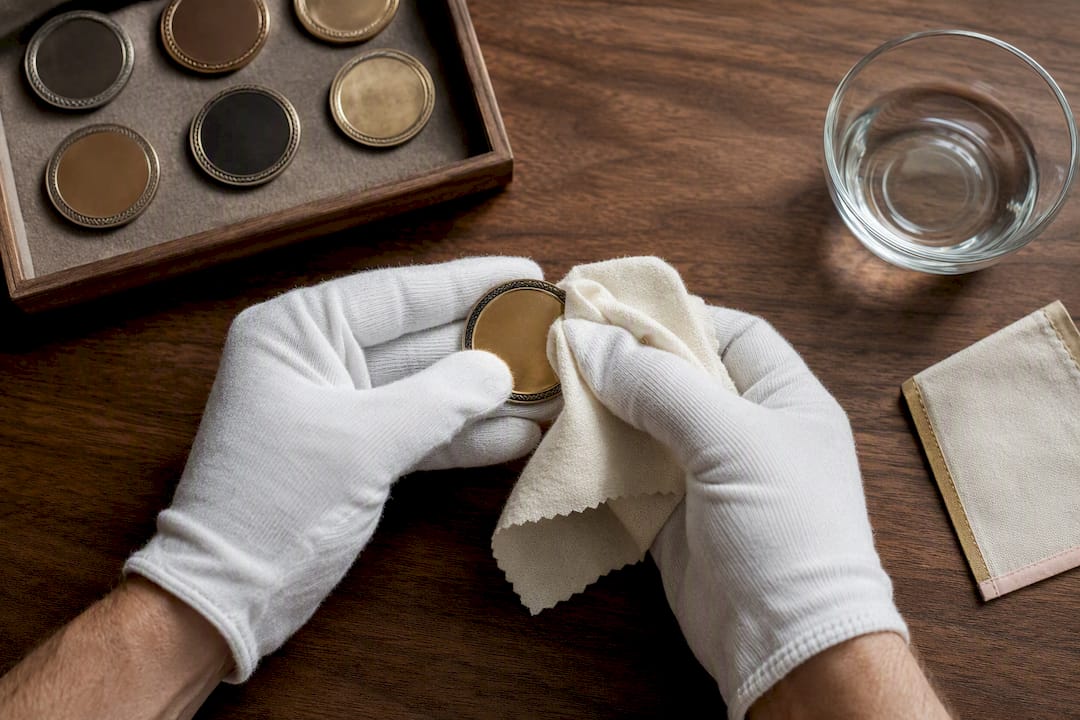
Wear cotton gloves or handle coins by the rim if you are prepping several at once. Skin oils are mildly acidic, and repeated bare-hand contact over months is one of the quieter causes of dulled finish on an otherwise well-stored collection.
Inspect your rack, box, or capsule for dust buildup and moisture before remounting anything. A shadow box installed near a kitchen or bathroom wall picks up humidity swings that a display in a den or office never sees, and that moisture is what starts oxidation on metal you thought was sealed away safely.
Thematic Grouping Ideas Beyond Chronological Order
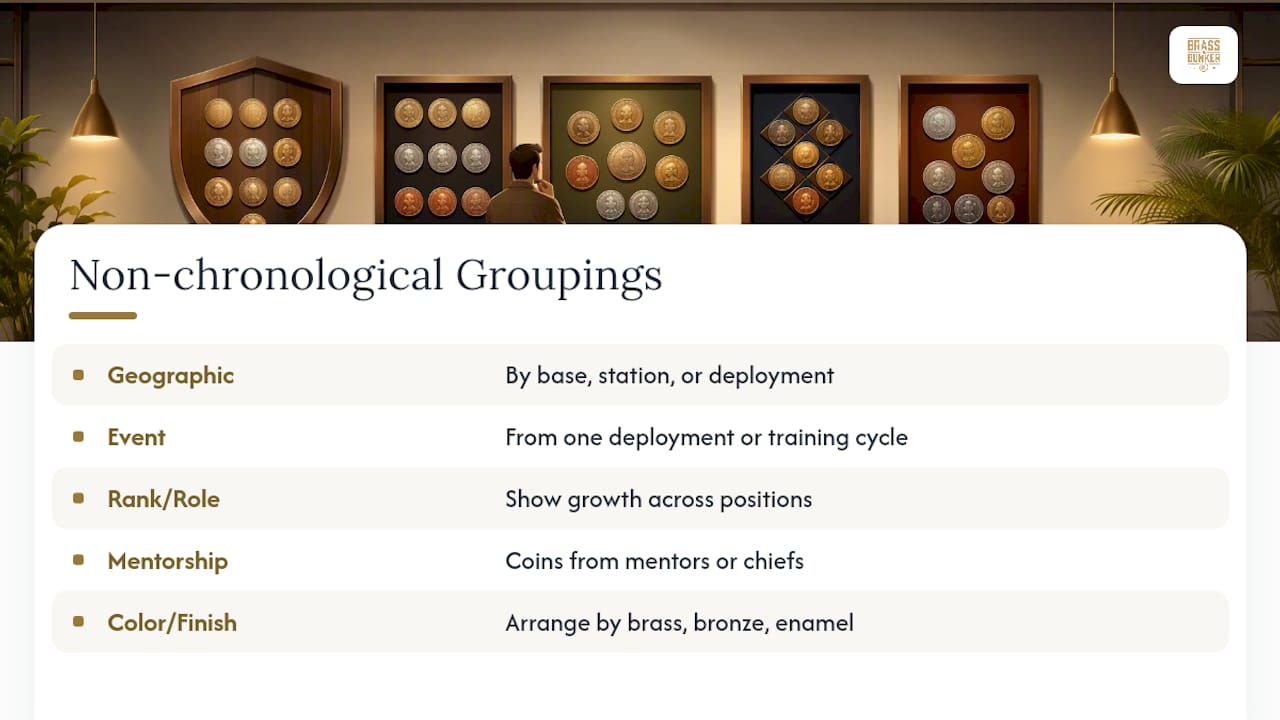
Chronological order works, but it is not the only story a collection can tell. Geographic grouping arranges coins by base, station, or deployment location, which turns a display into a map of where a career actually happened rather than just when.
Event-based grouping is another strong option: cluster coins earned during a single deployment, a specific incident response, or a training cycle, then let that cluster anchor its own shadow box or rack section. This works especially well for first responders and veterans whose coins mark distinct chapters rather than a steady progression through rank.
Rank or role-based grouping suits collectors who moved between assignments, letting a display show growth across positions instead of a flat timeline. A mentorship or gift grouping, coins received from specific commanding officers, chiefs, or colleagues, adds a personal layer no chronological arrangement can capture on its own. Color and finish grouping, arranging by brass, antique bronze, or enamel style, gives a display visual rhythm even when the coins themselves come from unrelated units or years. None of these approaches is more correct than chronological order. They just tell a different version of the same collection.
Mixing Coins Into Shadow Boxes With Other Memorabilia
A shadow box does its best work when a coin is not the only thing inside it. Pairing a coin with a folded flag section, unit patches, rank insignia, or a small printed photo turns a single object into a scene, and that combination tends to hold more meaning for family members than a coin alone ever could.
Layer depth matters here. Mount the coin slightly forward of flatter items like patches or photos so it catches light and draws the eye first, then build outward from there. Ribbon bars, name tapes, and small engraved plates all sit well in the same frame without competing for attention if you keep the coin as the visual anchor.
For retirement or memorial displays, a shadow box built around a single coin alongside a folded department patch and a short engraved plate often carries more weight than a full rack of coins ever will. It is a smaller piece, but a far more personal one. Reading more on the meaning behind challenge coin traditions can help you decide which pieces actually belong together in a single box.
Locking Cases and Other Security Considerations
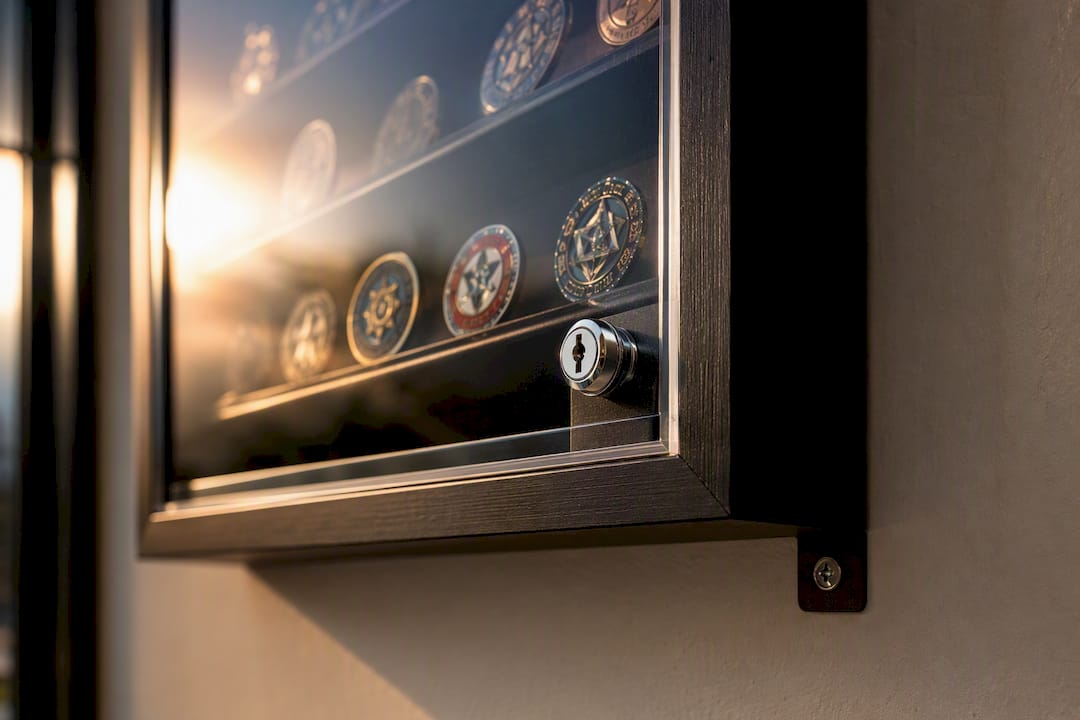
A display is only as good as its worst day, and that usually means the day something goes missing or gets knocked to the floor. If a collection includes rare or irreplaceable coins, a locking tabletop or wall-mounted case is worth the extra cost over an open rack, especially in a home office, shared space, or anywhere with regular foot traffic.
Glass fronts look sharp but crack on impact more easily than acrylic, so a case hung in a hallway or near a doorway benefits from acrylic glazing instead. For genuinely valuable or sentimental coins, consider a case with a simple key lock rather than relying on placement alone to keep curious hands away. Anchoring wall cabinets to studs, not just drywall anchors, matters more than most people think. A heavy shadow box that comes loose does more damage to the coins inside than almost any other display failure. If you are displaying coins in a space with children or frequent visitors, keeping the most fragile or valuable pieces at a higher mount point or inside a locked case rather than an open rack is a simple decision that prevents a lot of regret later.
A First Responder’s Take on Displaying What You Earned
This company was built by individuals who understand that a coin is never just metal. It is a shift, a call, a name remembered. That is why preservation matters as much as presentation. A coin stored right and displayed with care keeps its story readable for the next generation, not just the collector who earned it. You can find more of that storytelling on our blog.
— Brass & Bunker Co
Rounding Out a Display With Apparel and Gifts
A great coin display deserves company, and that is where Brass & Bunker Co comes in, not as a display case maker, but as the place to build out the rest of the moment around it. If you are putting together a retirement gift, a promotion ceremony, or a shadow box tribute, pairing it with durable, purpose-built firefighter apparel gives the honoree something to wear alongside something to hang.

Think engraved plaques next to a rack, or a heavyweight hoodie handed over at the same ceremony where a coin gets framed. Brass & Bunker Co apparel is built the same way a good display should be: made to last, made with intent, and made to mean something years down the road. Browse the collection and put together a gift that stands next to the coin, not in competition with it.
Sources
- Fast and easy way to make a challenge coin display
- Osborne Builder’s Studio: Challenge Coin/Medal Display Stand
- How to Display Your Challenge Coin Collection (From Desk to Wall)
- Imprintnow
- How to Store and Display Your Challenge Coin Collection Safely
FAQ
How Do You Make Your Own Challenge Coin Display?
Cut coin slots at roughly 14 degrees, space them about 1 inch apart, and test-fit your thickest coin before finalizing groove depth. A 12-inch rack typically holds around 20 coins, and setting your cut depth once, then keeping it consistent across every slot, is what separates a clean build from an uneven one.
Does Hobby Lobby Sell Challenge Coin Displays?
Craft retailers like Hobby Lobby carry shadow boxes and frames that collectors adapt for coins, though they are not built specifically for the job. Many collectors prefer a purpose-cut rack or a floating frame designed around coin thickness and viewing angle instead.
What Is the Etiquette for Challenge Coins?
Challenge coin etiquette centers on respect: never let a coin sit in a wallet where it gets scratched, never turn down a coin offered to you, and display coins in a way that honors the person, unit, or event they represent rather than treating them as loose currency.
What Are the Most Effective Ways to Display a Coin Collection?
Shadow boxes, tiered wooden racks, wall cabinets, acrylic capsules, floating frames, and rotating stands each suit different collection sizes and goals. Small collections do best with a tabletop rack or single floating frame, while collections over 75 coins usually need a wall cabinet or modular grid system to stay organized as they grow.

