

Activity First Lined vs. Unlined Shorts: Firefighter Founded Advice
Sep 21, 2026
For most runners, HIIT athletes, and anyone doing repetitive, high-impact work, lined shorts win on built-in support and chafe protection. For lifting days, hot-weather training, and everyday wear, unlined shells paired with your own base layer win on airflow, durability, and control over fit. The real trade-off comes down to integrated convenience versus customization, and the right answer changes with your activity, the climate, and how far you’re going.
TL;DR:
- Lined shorts provide built-in support and help manage friction, making them ideal for running, HIIT, and high-impact activities, especially during race day.
- Unlined shells are heavier, more durable, and better suited for weightlifting, casual wear, and hot climates because they allow for customizable base layers and improved airflow.
- Support from liners is limited and can cause discomfort if they shift or bunch, while unlined shorts rely on external layers to prevent chafing and enhance support.
- Durability favors unlined shorts, as liners tend to wear out faster due to elastic deterioration and seam failure over time.
- Choosing the right short depends on activity, climate, and personal fit, with durability and long-term performance prioritized over built-in convenience.
Table of Contents
- Lined vs. Unlined Shorts: What Does “Lined” Actually Mean?
- Lined vs. Unlined Shorts: What’s Different About an Unlined Shell?
- Support, Chafing, Heat, and Fit: Where the Two Styles Actually Diverge
- How Do You Choose Between Lined and Unlined Shorts?
- How Do I Wear Lined and Unlined Shorts Correctly?
- What Wears Out First: Liner or Shell?
- Why Brass & Bunker Co Builds Shorts the Way We Do
- What This Comparison Actually Proves
- Find Durable Training Shorts Built to Outlast the Workout
- Sources
- FAQ
Lined vs. Unlined Shorts: What Does “Lined” Actually Mean?
A lined short has a second layer of fabric sewn into the shell, sitting directly against your skin the way underwear would. That inner layer, the liner, does the job of managing friction and sweat so you don’t need to wear anything underneath. Liners come in a handful of styles, and the differences matter more than most buyers realize.
- Brief-style liners sit loose through the leg, similar to classic underwear, and prioritize airflow over hold.
- Boxer-brief liners extend a bit longer and offer more coverage, which some runners prefer to cut down on inner-thigh rub.
- Compression-style liners hug close to the body and function almost like built-in spandex shorts, adding light muscle support.
Most liners are cut from mesh or a polyester and spandex blend, chosen for quick-drying performance rather than softness. Better-made liners add flatlock seams to reduce rubbing, anti-odor treatments to fight bacteria buildup, and sometimes a small pocket for a key or gel packet. The concept is simple: one sewn-in layer replaces your underwear and takes on the friction so the outer shell doesn’t have to.
Lined vs. Unlined Shorts: What’s Different About an Unlined Shell?
Unlined shorts skip the built-in layer entirely. What you get is a single shell, and you decide what goes underneath, whether that’s seamless briefs, dedicated compression shorts, or full-length tights on cold days. That decision point is exactly what makes unlined shorts appeal to a wider range of activities, since Men’s Health notes that shell-only shorts offer more flexibility and tend to perform better in hot weather.
- Shell fabrics on unlined shorts often run heavier and more durable than liner material, since they don’t need to move against skin all day.
- More pockets, sturdier zippers, and a heavier drape make unlined shorts easier to wear straight through a workout and into the rest of your day.
- Because the base layer underneath is what actually touches your skin, you can wash it every session while wearing the outer shell more than once, depending on how much you sweat.
That last point surprises a lot of buyers. An unlined short isn’t automatically a “wash every time” item the way a liner is, since the shell itself picks up less direct sweat contact.
Support, Chafing, Heat, and Fit: Where the Two Styles Actually Diverge
Every argument about lined versus unlined shorts comes down to four practical factors, and each one cuts a different way depending on your body and your workout.
- Support: A compression liner offers some hold, but it’s built into a short designed to move, so it rarely matches the consistency of a standalone compression base layer worn underneath a shell.
- Chafing: Liners reduce skin-to-shell friction in most cases, which lines up with Cleveland Clinic’s guidance that smooth, moisture-wicking layers are one of the most reliable ways to prevent chafing. The catch is that a liner only helps while it stays in place. Once it shifts or bunches, it can create a new friction point instead of preventing one.
- Breathability: Two layers of fabric trap more heat than one. GearJunkie’s reporting on long-distance runners found that a single shell paired with an ultralight, moisture-wicking base layer often felt cooler over long durations than a traditional lined short.
- Fit variability: Liner seam and elastic placement is a fixed design choice, and it doesn’t match everybody the same way. Men’s Health points out that a liner some runners swear by can be the exact liner that irritates someone else’s inner thigh.
Pro Tip: If a liner has ever caused a hot spot on the inside of your thigh, that’s a fit mismatch, not a defect. Switching to an unlined short with a compression base layer of your own choosing often solves it permanently.
How Do You Choose Between Lined and Unlined Shorts?
Once you know what you’re doing in the shorts, the decision gets simple. Chexlow’s buying guide frames it as an activity-first question, and that’s the right way to think about it.
- Running, HIIT, or repetitive-stride training: Go lined. The built-in liner handles friction from constant leg movement without extra thought.
- Weightlifting, mobility work, or casual wear: Go unlined. You get better range of motion and a shell that works outside the gym too.
- Distance running past the 90-minute mark: Lean unlined with a trusted compression layer. A liner that’s fine for 5 miles can shift or soak through by mile 15.
- Hot or humid climate, regardless of activity: Go unlined. A single shell paired with a wicking base layer manages heat better than a two-layer liner setup.
Pro Tip: Race day is the one place where a familiar lined short usually beats experimenting with something new. Save gear testing for training runs, not race mornings.
How Do I Wear Lined and Unlined Shorts Correctly?
Wearing underwear over a liner defeats the entire purpose of the liner, and it also doubles the number of seams pressing against your skin. Skip it. If you’ve got lined shorts, the liner is your underwear.
For unlined shells, your base layer choice depends on what you’re doing:
- Seamless briefs work fine for lifting sessions or errands where friction isn’t a real concern.
- Dedicated compression shorts are the better call for running or any activity with repetitive leg movement.
- Tights make sense in cold weather or when you want extra coverage under a looser shell.
Fit problems usually show up as bunching or a seam that sits wrong. Try the short on and move through a full range of motion, not just standing still, since liners that feel fine at rest can ride up mid-stride. Check the mirror for seam placement at the hip and inner thigh, and don’t guess on inseam length. A short cut too long for your leg changes how the liner sits entirely; Brass & Bunker Co’s shorts inseam guide breaks down how to measure it correctly.
On hygiene, the liner touches skin directly, so wash it after every session. The outer shell can go a wash or two longer if sweat contact stayed light.
What Wears Out First: Liner or Shell?
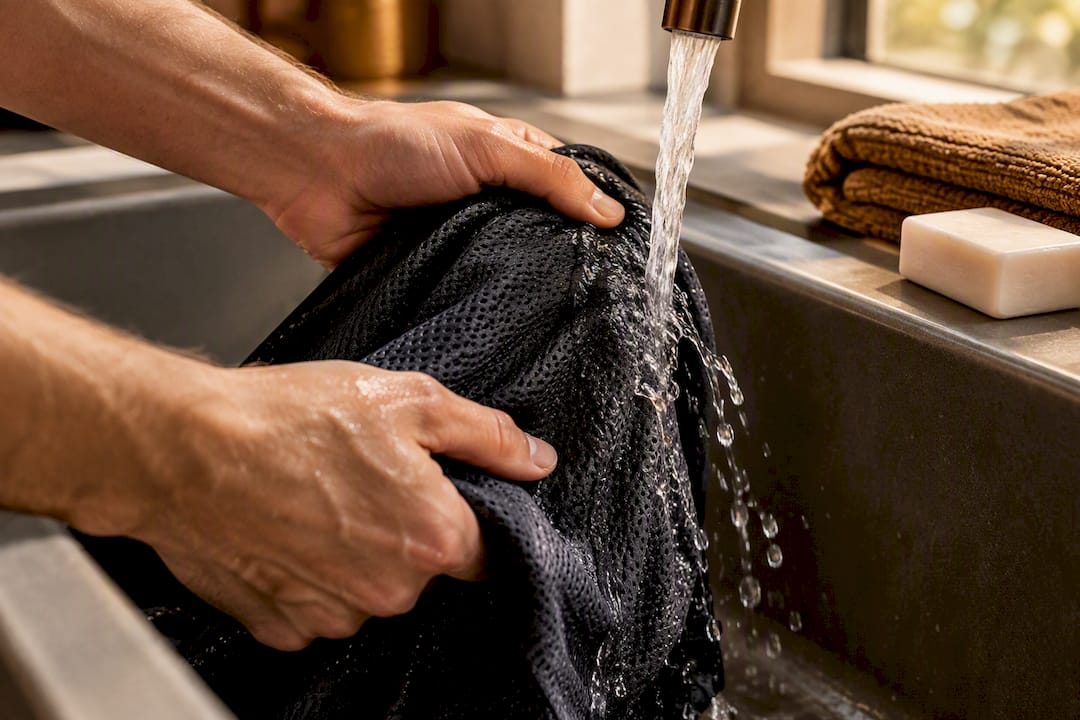
Liners take the brunt of the damage. The combination of stretch, friction, and repeated washing breaks down liner elastic and seams well before the outer shell shows any wear, which is one reason shell-only shorts tend to outlast lined pairs in daily rotation.
A few habits stretch the life of either style:
- Wash in cold or warm water on a gentle cycle, never hot, to protect wicking fabric.
- Skip fabric softener and bleach. Both coat synthetic fibers and kill moisture-wicking performance over time.
- Hang to dry instead of tumble drying on high heat, which breaks down elastic faster than almost anything else.
- Check liner seams and waistband elastic every few months. Loose stitching or elastic that’s lost its snap is your signal to repair or retire the piece, not push through another season.
Why Brass & Bunker Co Builds Shorts the Way We Do
The brand was founded by individuals with experience in firefighting and product design, and that pairing shows up in every stitch. Firefighters don’t get to pick gear based on trends. They pick gear based on what survives a shift, and that mindset carries straight into how we approach training apparel.
Unlined, durability-first shells fit that philosophy naturally. A shell built from heavier fabric, without a liner to wear out first, holds up better across the kind of repeated, hard use that first responders and serious trainees put their gear through. That’s not a knock on lined shorts, which earn their place for runners and race day. It’s why our lineup leans toward shells you can trust to outlast the workout, the wash cycle, and the season.
What This Comparison Actually Proves
The conventional gear advice treats this as a personal preference question, and that’s where it falls short. Preference matters less than physics here. Two layers of fabric trap more heat than one, full stop, and a sewn-in liner cut for an average body will always fit some people better than others. That’s not opinion, it’s construction.
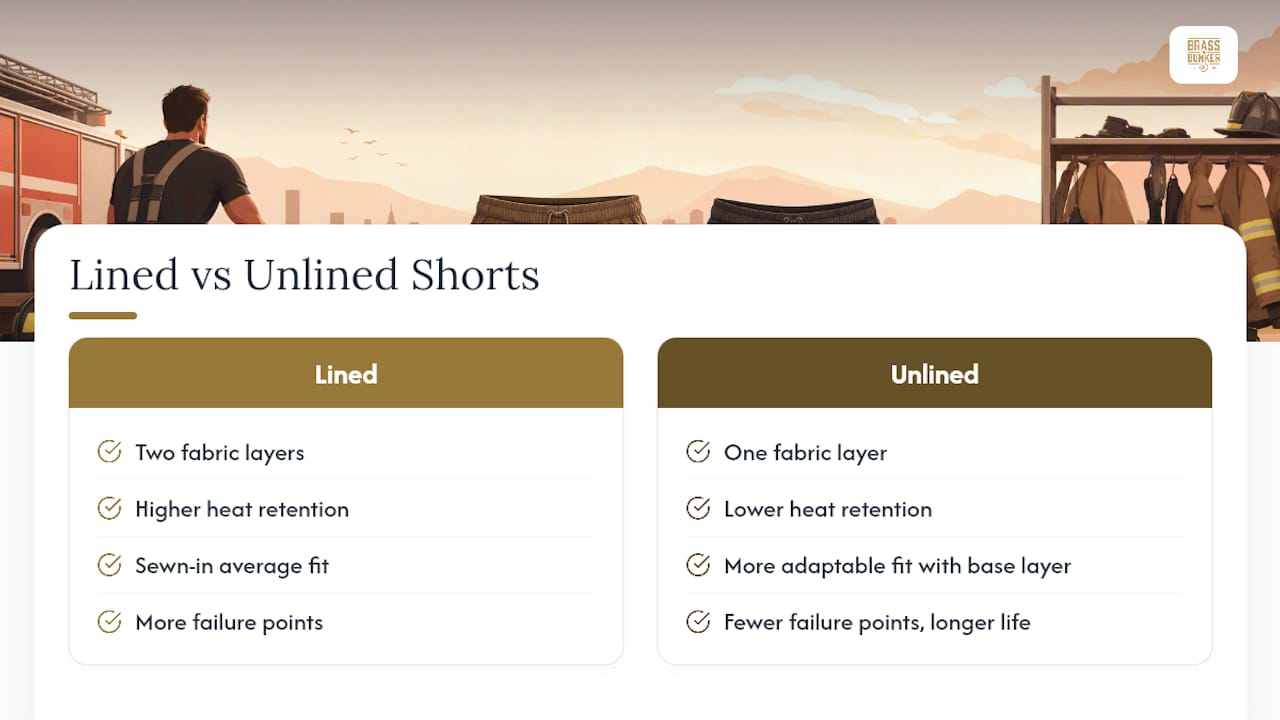
Where the standard advice gets it right is the activity-first framing: match the short to the movement pattern, not the marketing copy on the tag. A liner earns its keep during a 5K where consistent, repetitive friction is the enemy. It becomes a liability on a 20-mile long run where saturation and shift are the bigger risks.
What we’d tell you to prioritize first is durability over convenience. A liner is one more part that can fail: elastic that gives out, seams that separate, fabric that traps heat when you need it least. A well-built unlined shell paired with a base layer you already trust gives you fewer points of failure and a longer service life, which matters more to people who wear their gear hard, day after day, than any built-in feature ever will.
— Brass & Bunker Co
Find Durable Training Shorts Built to Outlast the Workout
If you’ve decided an unlined shell fits your training better, Brass & Bunker Co’s shorts collection is built around exactly that philosophy: heavier fabric, fewer failure points, and a fit designed to work in the gym and out of it. Every piece follows high standards demanding durable gear, built to take the beating so you don’t have to think twice about it.

If you’re gearing up for repetitive-stride training like running or race day, our women’s running shorts show how we approach built-in support without cutting corners on quality. For lifting days, casual wear, or anything where you want a shell tough enough for daily rotation, the Tiger Stripe Workout Shorts hold up to exactly that kind of use. Not sure what inseam fits your build? Check our shorts inseam guide before you order, and for quick outfit ideas to pair with your base layer, My Tenue’s gym styling guide is a solid resource. Browse the current lineup and find the pair built for how you actually train.
Sources
- Lined vs Unlined Gym Shorts: Which Are Better for Workouts? | Men’s Health
- Running debate: lined vs. unlined running shorts | GearJunkie
- Chafing - Symptoms and causes | Cleveland Clinic
- Lined vs Unlined Gym Shorts, How to Pick Your First Pair | Chexlow
FAQ
What Is the Difference Between Lined and Unlined Shorts?
Lined shorts have a built-in liner sewn against the skin that replaces underwear, while unlined shorts are a single shell that requires a separate base layer. The choice comes down to whether you want integrated convenience or the ability to pick your own fit and coverage underneath.
What Is the Point of Lined Shorts?
Lined shorts exist to cut down on friction during repetitive movement, like running or HIIT circuits, without needing extra layers. GearJunkie notes they’re especially convenient for race day since there’s nothing extra to think about underneath.
Do You Wear Underwear With Lined Shorts?
No. The liner is designed to function as your underwear, and adding another layer on top creates extra seams and friction points that can cause the exact chafing the liner is meant to prevent.
Do Guys Like Lined or Unlined Shorts?
Preference splits by activity more than anything else. Runners and HIIT athletes often favor lined shorts for built-in support, while lifters and everyday wearers tend to prefer unlined shells like the durable styles in Brass & Bunker Co’s shorts collection for their versatility and airflow.

